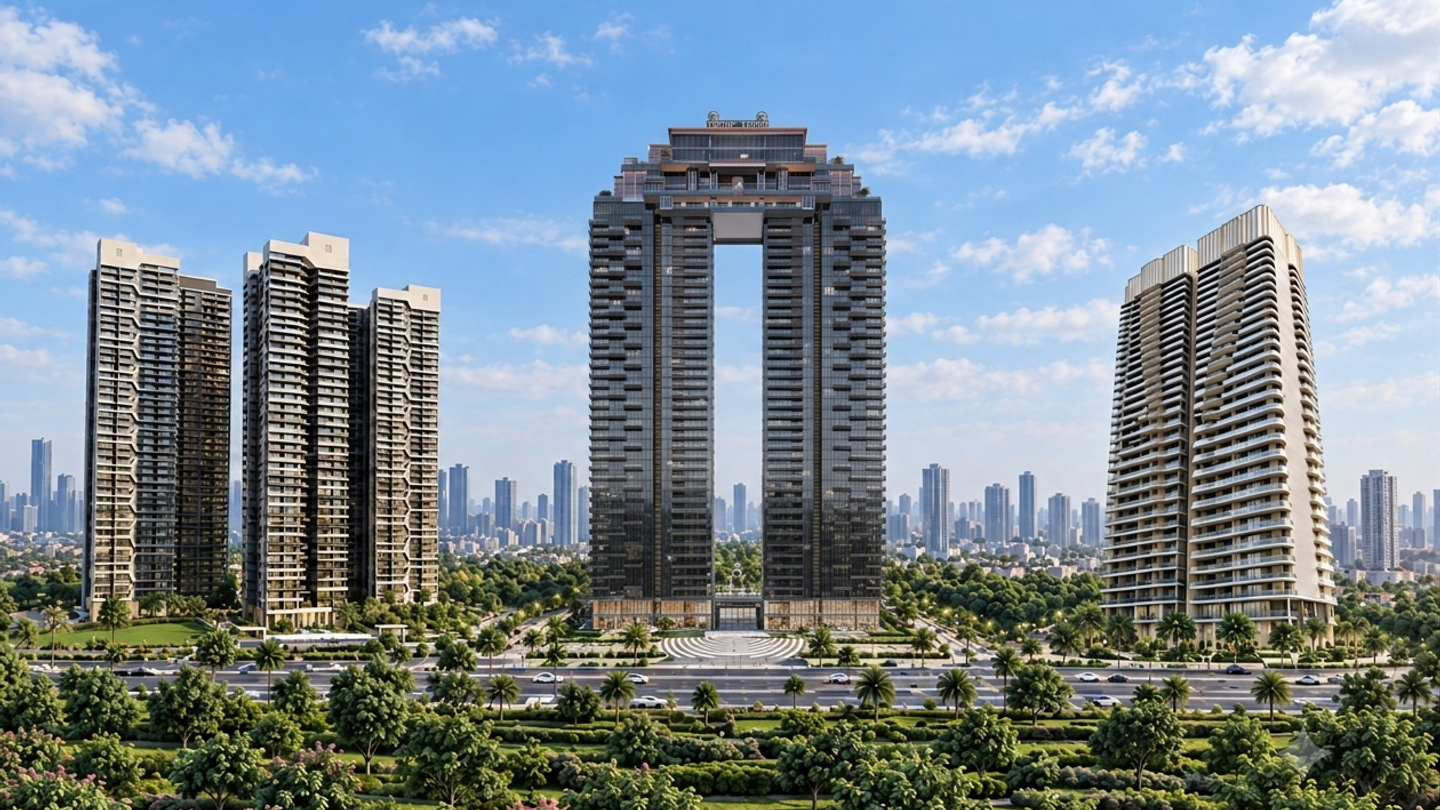
Branded Residences: When Your Home Becomes a Hospitality Experience
A decade ago, luxury real estate was largely about three things: Location, Architecture, Developer reputation. Today, a fourth dimension is rapidly becoming important: Brand.
The global real estate market has created a new category in which a luxury home is associated with a recognised hospitality, fashion, lifestyle, or luxury brand. These are branded residences. A branded residence combines private home ownership with the design standards, service culture, operating discipline, and brand recognition of a luxury hospitality or lifestyle company.
Four Seasons. Ritz-Carlton. St. Regis. Westin. Trump. The Leela. Armani/Casa. YOO.
The concept is no longer restricted to London, New York or Dubai. It is now becoming increasingly visible in India. But there is an important distinction: A famous logo does not automatically make a property a good investment. The real question is: How much economic value does the brand actually add to the property?
What Is a Branded Residence?
A branded residence is a privately owned luxury home such as an apartment, villa or penthouse, developed in association with a recognised hospitality, fashion, design or lifestyle brand. The brand may contribute its identity, design standards, service protocols, management expertise and resident experience to the development.
The concept emerged in 1927 with New York’s Sherry-Netherland Hotel, one of the earliest examples of the hotel-residence model. Since then, branded residences have expanded beyond traditional hospitality brands into fashion, design, automotive and luxury lifestyle brands, becoming an increasingly important segment of the global luxury housing market.
The growth of branded residences addresses a gap between traditional luxury housing and luxury hospitality. A conventional luxury project may offer a prime location, large homes, premium specifications, and extensive amenities. Still, a branded residence adds another layer: an ongoing service and experience proposition tied to the brand.
How Does the Branded Residence Model Work?
The simplest way to understand the model is: Developer + Brand + Buyer. In a branded residence, the developer typically brings the land, development expertise, capital, approvals, construction capabilities and sales network. In contrast, the brand contributes some combination of brand equity, design standards, operating standards, service protocols, global recognition, marketing credibility and hospitality expertise. The exact division of responsibilities varies by project and the nature of the brand partnership.
The buyer receives: A home + an experience + the association with the brand.
The developer, meanwhile, may be able to sell the property at a higher price because the brand creates additional perceived and/or actual value. This raises the central economic question: Does the additional price the buyer pays justify the additional value the brand creates?
Types of Branded Residences
Not every branded residence is the same. prOPIUM broadly categorises them into four models.
Model 1: Hotel-Integrated Residences
The residences are physically integrated with, or adjacent to, a hotel operated by the same hospitality brand. Examples include: Four Seasons Private Residences at Embassy ONE, Bengaluru and Three Sixty West / Ritz-Carlton, Mumbai. This is arguably the strongest form of the branded-residence proposition because the buyer can experience the hospitality operation rather than merely seeing a logo.
Model 2: Standalone Branded Residences
No hotel may be attached to the residential development. The brand licenses its name and provides defined design, service or operating standards. This model can work extremely well, but the buyer needs to understand exactly what the brand is contractually responsible for. Examples include Armani/Casa in Miami and Porsche Design Tower.
Model 3: Lifestyle / Fashion-Branded Residences
Here, the value proposition comes primarily from design, aesthetics, brand identity, exclusivity and lifestyle positioning, with the brand potentially having less involvement in the day-to-day operation and management of the property. This distinction between a design-led brand and an operating brand matters when evaluating a branded residence. Brands like Armani, Bulgari, Porsche, and Fendi bring their design DNA to residential living without a traditional hotel background.
Model 4: Developer-Created "Branded Luxury"
Some developers create strong proprietary luxury brands without partnering with an external global brand. These projects may combine high-end architecture, exceptional specifications, concierge services, low-density planning, large residences and premium amenities to create an elevated living experience that goes beyond the physical apartment itself. They may compete directly with branded residences.
This is why the comparison should not simply be: Branded vs Unbranded. It should be: Branded vs Comparable Luxury Product.
Hospitality, Fashion, Automotive and Design Brands
Brand Category | Examples | Typical Value Contribution |
Hospitality | Four Seasons, Ritz-Carlton, Westin, Taj, Leela | Service standards, operations, concierge, hospitality expertise |
Fashion | ELIE SAAB, Armani/Casa, Versace | Design language, interiors, identity and exclusivity |
Automotive | Tonino Lamborghini, Porsche Design | Design DNA, lifestyle identity and product differentiation |
Design | YOO, Philippe Starck, Kelly Hoppen | Architecture, interiors and recognisable design philosophy |
Lifestyle / Luxury | Trump, Jacob & Co. | Global recognition, luxury positioning and marketing identity |
Benefits of Branded Residences
View the benefits of a branded residence from three perspectives: the buyer, the developer, and the investment.
Benefits for the Buyer
Brand assurance- The most obvious benefit is the association with an established brand. The brand can provide greater clarity around the expected level of design, service, hospitality, maintenance, and resident experience. However, the strength of this benefit depends on the actual scope of the brand agreement.
Better service- Branded residences typically offer services that go beyond those found in conventional residential projects. Depending on the project, these may include concierge, housekeeping, valet services, in-residence dining, maintenance services, wellness facilities, spa services, private dining, event management and personal assistance. The exact offering varies by project, which makes the service matrix an important part of evaluating a branded residence.
Lifestyle and convenience- For many buyers, the attraction is not simply luxury specifications but convenience. The proposition is: Everything required for a premium lifestyle is available within the residence or through the residence's service ecosystem. This is particularly relevant for second homes and residences used intermittently.
Potential resale differentiation- A branded residence can potentially have an advantage when it comes back to the market because it offers something beyond size, location and specifications. A resale buyer is not only evaluating: “How big is the apartment?” but also: “What experience does this property provide?”
That differentiation can become important in markets where multiple luxury developments compete for the same buyer.
Benefits for the Developer
For developers, the brand provides a powerful positioning tool.
Premium positioning- The association with a recognised brand can help position a project at the higher end of the market. It can support higher ticket sizes, premium pricing, stronger differentiation, international marketing and access to a wider customer base. However, the brand alone cannot justify a premium. The underlying location, product, architecture, density, specifications, services and pricing still determine whether the premium is sustainable.
Access to a new customer base- A global brand can bring an existing customer ecosystem into the residential project. For a developer, this can potentially expand the market beyond traditional local residential buyers.
Stronger project identity- Luxury residential developments can sometimes become difficult to distinguish from one another. A recognised brand gives the project a clear identity and narrative. Instead of selling only: “a luxury apartment in a premium location,” the developer can sell, “a particular branded lifestyle.”
Benefits as an Investment
The investment case for branded residences is more nuanced. A branded residence can potentially benefit from:
Pricing premium- The association with a strong brand can support a premium over comparable non-branded residences. But the important question is: How much of that premium is justified by the additional value the brand creates? A ₹10 crore branded apartment is not necessarily a better investment than an ₹8 crore non-branded apartment simply because it carries a prestigious name. The investor must evaluate the premium paid versus the incremental value received.
Rental potential- Branded residences can potentially command stronger rents where tenants value service, convenience, security, location, hospitality, amenities and brand association. This is particularly relevant for high-income professionals, expatriates and corporate tenants.
Resale liquidity- A recognised brand can potentially make the property easier to identify and differentiate in the resale market. But liquidity ultimately depends on the combination of: Location + Product + Brand + Pricing + Supply + Service Quality. The brand is only one component.
Why India Is Different for Branded Residences?
India's branded residence opportunity has a particularly interesting characteristic: The developer still matters enormously. In mature global markets, the brand itself can carry substantial credibility. In India, buyers often evaluate Brand + Developer + Location together. This creates a three-layer trust equation:
Layer 1 - Developer credibility
Can the developer actually deliver the product?
Layer 2 - Brand credibility
Will the brand maintain its standards?
Layer 3 - Location credibility
Will the address remain desirable? A strong brand cannot compensate indefinitely for a weak location. A strong developer also cannot always justify an excessive brand premium.
Where Are Branded Residences Growing?
City-Wise Branded Residence Market
India's branded-residence opportunity is not evenly distributed. It is concentrated where affluent demand, international connectivity, premium land values, developer capability and luxury consumption overlap. Noesis' 2025 report tracks operational and planned branded-residence activity across the following markets:
Market | Luxury / Branded Residence Character | Key Demand Drivers |
Delhi NCR | Fast-expanding mix of hospitality, fashion and lifestyle brands | Corporate wealth, NRI demand, new luxury corridors |
Mumbai | India's deepest established ultra-luxury market | Scarce land, concentrated wealth, global brand familiarity |
Pune | Early adopter outside Mumbai/NCR | Established luxury enclaves and branded project precedents |
Bengaluru | Hospitality-led and globally exposed buyer base | Technology wealth, founders, multinational ecosystem |
Hyderabad | Emerging branded-luxury opportunity | Technology wealth, infrastructure and premium western corridor |
Chennai | Selective luxury and hospitality-linked demand | Affluent end-users and established business families |
Kolkata | Selective branded projects | Legacy wealth and premium central locations |
Odisha / Emerging Markets | Early-stage pipeline | Destination-led and new luxury demand |
The market remains concentrated in a small set of cities where wealth, luxury housing demand, international connectivity, infrastructure and developer capability overlap.
Branded residences require a particular combination of wealth, luxury housing demand, international connectivity, corporate activity, infrastructure, developer capability and scarcity. These factors tend to exist together only in select locations, which is why the branded residence market remains concentrated in a handful of major cities rather than being evenly distributed across the country.
List of All Branded Residences in India
City | Project | Branded Partner | Developer / Partner |
Mumbai | The World Towers, Worli | Armani/Casa | Lodha Group |
Mumbai | Four Seasons Private Residences, Worli | Four Seasons | Provenance Land |
Mumbai | Trump Towers, Worli | Trump | Lodha Group / Tribeca |
Mumbai | Three Sixty West, Worli | The Ritz-Carlton | Oberoi Realty |
Mumbai | ABIL Mansion, South Mumbai | Versace Home | ABIL Group |
Mumbai | The Trees, Vikhroli – hospitality component | Taj / IHCL association | Godrej Properties |
Pune | Trump Towers Pune | Trump | Panchshil Realty / Tribeca |
Pune | YOO Pune | YOO Inspired by Starck / Philippe Starck | Panchshil Realty |
Pune | YOO Villas | YOO / Kelly Hoppen | Panchshil Realty |
Bengaluru | Four Seasons Residences Bengaluru | Four Seasons | Embassy One Development |
Bengaluru | Prestige Leela Residences | The Leela | Prestige Group |
Bengaluru | Brigade Gateway Enclave / Sheraton-linked residences | Sheraton | Brigade Group |
Chennai | Taj Sky View | Taj / IHCL | Ampa Group |
Kolkata | Trump Tower Kolkata | Trump Organization | Tribeca / Unimark / RDB Group |
Eastern & Northeastern India | Taj Branded Villas & Residences | IHCL (Taj) | Ambuja Neotia Group |
Hyderabad | YOO Hyderabad | YOO Studio | Myscape India |
Goa | G.O.A.A. Premium Residences | Miros Hotels & Resorts | House of Abhinandan Lodha (HoABL) |
Jaipur | Waldorf Astoria Jaipur Residences | Hilton / Waldorf Astoria | Dangayach Group |
Gurugram | Trump Tower Delhi NCR, Sector 65 | Trump Organization | M3M India / Tribeca Developers |
Gurugram | Trump Residences Gurugram, Sector 69 | Trump Organization | Smartworld Developers / Tribeca |
Gurugram | Westin Residences Gurugram, Sector 103 | Westin / Marriott International | Whiteland Corp |
Gurugram | Tonino Lamborghini Residences, Sector 71 | Tonino Lamborghini | |
Gurugram | The Falcon, Sector 53 | YOO Inspired by Starck | |
Gurugram | M3M ELIE SAAB, Sector 111 | ELIE SAAB | |
Noida | Trump Towers Noida, Sector 94 | Trump Organization | M3M India / Tribeca Developers |
Noida | Jacob & Co Residences, Sector 97 | Jacob & Co. | M3M India |
Noida | Residences by ELIE SAAB, Sector 98 | ELIE SAAB | Smartworld Developers |
Noida | Hyatt House Noida, Sector 140A | Hyatt Hotels | CRC Group |
Noida | Taj Skyscape, Sector 144 | Taj | Gulshan Group |
What Exactly Are Buyers Paying For Branded Residence?
When buying a branded residence, the price you pay can be viewed as a combination of several components:
Components | Explanation |
Land Value | The underlying value of the land on which the project is developed. |
Construction Value | The cost and value of the structure, finishes, MEP systems, specifications and overall construction quality. |
Developer Premium | The value associated with the developer’s reputation, execution capability and track record. |
Location Premium | The additional value attributable to the quality, connectivity and desirability of the address. |
Amenity Premium | The value created by amenities such as clubhouses, landscaping, wellness facilities, pools, sports facilities and lifestyle infrastructure. |
Service Premium | The value of services such as concierge, housekeeping, valet, maintenance and hospitality operations. |
Brand Premium | The economic value attributable specifically to the brand and its associated reputation, design standards, service proposition and customer recognition. |
Scarcity Premium | The value created by limited supply, low density, unique product characteristics or an otherwise difficult-to-replicate offering. |
This distinction is critical. The entire price premium of a branded residence cannot automatically be attributed to the brand. If a branded residence costs ₹40 crore, for example, it does not mean that the brand contributes ₹10 crore of value. The price may reflect several overlapping premiums including location, product quality, developer reputation, amenities, services, scarcity and the brand itself. The real analytical question is therefore: how much of the price is attributable to the brand, and how much is supported by the underlying real estate fundamentals?
Understanding the Brand Premium
One of the biggest questions surrounding branded residences is: how much more should a buyer pay for the brand?
There is no universal answer. The premium can vary significantly depending on the project, location, brand, developer, unit type, stage of construction, scarcity and comparable supply. Industry estimates can differ considerably, with some 2026 market observations indicating premiums in the 15–25% range for many projects, while exceptionally scarce or differentiated developments may command substantially higher premiums. Treat these figures as market observations, not a universal valuation rule.
prOPIUM’s approach is simpler: do not start with the premium. Start with the comparable.
First determine: What would this property be worth without the brand?
Then determine: What additional value does the brand actually create?
This approach separates the underlying real estate value from the brand premium, making it easier to assess whether the additional price is justified by the brand, services, scarcity and overall proposition.
Brand Premium % = (Branded Residence Price − Comparable Luxury Price) ÷ Comparable Luxury Price × 100
For example, if a truly comparable non-branded luxury property is ₹30,000 per sq. ft. and the branded residence is ₹36,000 per sq. ft., the observed premium is 20%. That 20%, however, should not automatically be called pure brand value: better specifications, lower density, services, views, scarcity and developer strength may explain part of the difference.
Why the Developer Still Matters for Branded Residences in India?
Imagine two otherwise identical branded residences.
Project A: Global brand + strong developer
Project B: Global brand + weaker developer
Should they be valued identically? Probably not. The brand does not build the building. The developer remains responsible for critical elements such as land, approvals, construction, execution, delivery, project management and much of the customer experience. A strong brand can enhance the proposition, but it cannot eliminate execution risk.
This is why prOPIUM separates Developer Strength from Brand Value. A globally recognised brand may build trust, design appeal, and service credibility, but underlying quality and investment outcomes still depend heavily on the developer’s ability to execute.
Service Is the Real Differentiator for Branded Residences
This is perhaps the most misunderstood part of branded residences. A luxury lobby is visible. A good concierge is experienced. The difference between an ordinary luxury project and a genuinely hospitality-led residence is often operational. Ask:
- Who manages the residence?
- Who employs the concierge?
- Who manages housekeeping?
- Who manages maintenance?
- Is the service mandatory or optional?
- What are the annual service charges?
- What happens if the brand-management agreement ends?
- Is there a service-level standard?
- Who monitors compliance?
The answer to these questions can tell you far more about the project than its brochure.
The Biggest Risk: Brand Without Substance
A dangerous misconception in branded real estate is that if a famous logo is on the building, the building must automatically be premium. Not necessarily. A branded residence's value depends heavily on how deeply the brand is involved. At one end, the brand may be deeply involved in design, construction standards, operations, resident services and quality audits. At a moderate level, its involvement may be limited to design, branding and selected services. In a primarily licensed model, the brand may contribute mainly its name, marketing and limited design guidelines. These three structures represent very different propositions and, therefore, should not receive the same valuation simply because they carry the same brand name.
The Contrarian Case: Why Branded Residences Could Disappoint
A growth thesis is only credible if it survives its own counter-arguments. While branded residences are expanding rapidly in India, three risks deserve serious consideration alongside the bullish outlook.
Risk 1: Oversupply Is Already Visible at the Corridor Level
India may still be undersupplied at an aggregate level, but branded residences are increasingly clustering within a limited number of micro-markets. Gurugram's Golf Course Extension Road and SPR corridor already have multiple branded developments associated with names such as Trump, Elie Saab, Jacob & Co. and Westin. Mumbai's Worli is showing similar signs of concentration.
When several branded developments compete for the same buyer pool within a relatively narrow geography, the category's fundamental promise of scarcity can begin to weaken. The current wave of announcements may also reflect developers seeking to secure a brand partnership before competitors do, rather than responding solely to incremental end-user demand.
This creates a critical question: Is the growth of branded residences being driven by genuine demand or by developers competing to differentiate their projects? NCR, with its large number of existing and upcoming branded developments, may be particularly exposed to this risk.
Risk 2: Hospitality Brands Risk Diluting the Asset That Makes Them Valuable
The premium associated with hospitality-branded residences is ultimately built on trust in the underlying brand's service standards. But that trust has limits. As global hotel operators attach their brands to more residential projects, maintaining consistent service quality across locations becomes harder. The brand may provide standards, operating frameworks, and reputation, but construction quality, project execution, and day-to-day asset management still depend heavily on each project's developer and operating structure.
This creates an important distinction: A branded residence does not automatically mean a branded-quality building. A highly visible failure in service delivery, construction quality or project execution could affect perceptions of branded residences more broadly, particularly in newer markets such as India, where the category is still developing.
For buyers, therefore, the relevant question is not simply: Which brand is attached to the project? It is: How deeply is the brand involved, who is responsible for delivery, and what happens if the promised experience is not delivered?
Risk 3: Will Buyers Continue Paying a Premium When Every Project Has a Brand?
This may be the most important long-term question for the category. When branded residences were relatively rare, the brand itself was a powerful differentiator. Today, fashion houses, watchmakers, automotive brands and lifestyle labels are entering the market alongside traditional hospitality operators.
As branded residences become more common, "branded" could gradually become a standard feature of premium real estate rather than a genuine differentiator. That creates a basic economic challenge. If branded supply increases faster than the pool of buyers willing to pay a premium, the brand premium could compress. The implication is important: the future of branded residences may not depend on whether the sector grows, but on whether individual projects can continue to justify their premium.
As buyers become more sophisticated and gain experience across complete development cycles, they may increasingly look beyond the brand name and evaluate the fundamentals of the underlying asset including location, developer credibility, construction quality, density and product efficiency, service delivery, maintenance costs, rental demand, resale liquidity and actual scarcity. Over time, these factors are likely to play an increasingly important role in determining whether a branded residence can sustain its premium beyond the initial launch.
What Happens If the Brand Leaves?
This is one of the most important questions buyers rarely ask. Many branded residences operate under licensing or brand-management agreements.
For example, the official Westin Residences Gurugram materials explicitly state that Whiteland develops the project and that use of the Westin trademarks is subject to a limited license; if the license terminates or expires without renewal, the project would no longer be associated with the Westin brand.
That is not necessarily a problem. But it demonstrates an important principle: A current example makes the point concrete: on 30 July 2026, Four Seasons announced that its management of the Four Seasons Hotel and Private Residences Bengaluru at Embassy ONE will conclude on 28 February 2027 under a mutual agreement with Embassy Group. The announcement does not diminish the residences as real estate; it shows that a brand and its operating relationship have a defined term. Buyers should distinguish the property, the service operator and the brand license.
Brand value is contractual, not permanent.
Therefore, every buyer should understand agreement duration, renewal provisions, termination rights, management rights, brand standards, and post-termination consequences. The brand should never be treated as an immutable property characteristic.
Total Cost of Ownership: The Hidden Cost of Branded Living
Before comparing returns, buyers should estimate total ownership costs rather than focusing only on the purchase price.
- Purchase consideration and applicable taxes / duties
- Maintenance and common-area charges
- Brand or hospitality service charges, where applicable
- Club and amenity charges
- Housekeeping, concierge and valet charges where optional or separately billed
- Property-management cost for absentee or NRI owners
- Interior / fit-out expenditure where the unit is not fully finished
- Reserve funds, major repairs and long-term building upkeep
5-Year Ownership Cost = Acquisition Cost + Transaction Costs + 5-Year Maintenance + Service Costs + Fit-Out / Management Costs
Who Should Buy a Branded Residence?
Branded residences can make particular sense for buyers who value convenience, service, privacy, international standards, hospitality, low-management ownership, brand recognition, second-home simplicity, NRI ownership and trophy properties. They may be less suitable for buyers whose primary objective is maximising rental yield at the lowest possible entry price, where the additional cost of branding and services may not necessarily translate into proportionately higher returns.
A branded residence is often an experience asset first and a financial asset second. The strongest propositions, however, can potentially combine both-offering a differentiated living experience while also delivering sound underlying real estate fundamentals.
Common Mistakes Buyers Make
Mistake 1: Buying the Logo
A famous brand does not automatically make a great property. Evaluate the brand alongside the location, developer, product, services, and overall project quality.
Mistake 2: Ignoring the Developer
Branding does not replace execution capability. The developer remains critical to construction quality, delivery, project management, and overall execution.
Mistake 3: Comparing Only ₹/sq. ft.
Luxury property requires more than a simple comparison of the headline price per square foot. Buyers should consider carpet-area efficiency, unit size, density, floor, views, parking, specifications, services and maintenance costs.
Mistake 4: Ignoring Recurring Costs
The brand premium is only the initial premium. Buyers should also understand the ongoing costs of maintenance, services, club facilities, concierge, housekeeping, parking, and property management.
Mistake 5: Assuming Appreciation
A branded residence may command a premium, but that does not guarantee that the premium will continue to expand. Future value will depend on factors such as location, scarcity, product quality, brand relevance, demand and competing supply.
Mistake 6: Ignoring the Resale Buyer
Every buyer should ask: “Who will buy my property from me in ten years?” The future buyer may evaluate the property very differently from today's buyer, placing greater or lesser importance on location, floor, view, developer, brand, service charges and the condition of the property. Understanding the potential future buyer is therefore an important part of evaluating a branded residence today.
The Future of Branded Residences in India
The next phase of branded residences is likely to extend beyond traditional hotel brands. We are already seeing interest from hospitality companies, luxury developers, fashion brands, automotive brands, wellness brands, design houses and international property networks. As this ecosystem expands, the category may gradually evolve from “branded residences” to “branded living.”
That distinction matters. The future luxury buyer may not simply purchase a home associated with a brand; they may purchase an integrated lifestyle ecosystem that combines the home with a club, wellness, dining, concierge, travel, experiences, and community. In that model, the value proposition extends beyond the apartment itself to the entire living experience.
Final Thoughts
Branded residences represent an important evolution in luxury real estate, bringing together two worlds that were traditionally separate: real estate ownership and hospitality. The strongest projects can offer something genuinely different a home that is not simply beautiful, but professionally serviced; a building that is not simply luxurious, but operationally managed; an address that is not simply expensive, but genuinely scarce; and a property that can potentially benefit from the credibility and recognition of a global brand.
Buyers should remember one fundamental principle: Never confuse a brand premium with brand value. A brand premium is what you pay. Brand value is what you receive.
The difference between the two is where the real investment decision lies and that is precisely what prOPIUM is designed to measure. prOPIUM - turning property data into decision intelligence.
FAQ's
What are branded residences in India?
Branded residences in India are luxury homes developed in association with recognised hospitality, fashion, design or lifestyle brands. The brand may contribute to design, services, operating standards, resident experience, marketing or overall positioning.
Which cities have branded residences in India?
Branded residences in India are concentrated mainly in Mumbai, Gurgaon, Bengaluru, Pune, Noida, Hyderabad, Jaipur, Goa and a few other premium urban or destination markets where luxury housing demand and affluent buyer concentration are stronger.
Are branded residences in India a good investment?
The investment potential of branded residences in India depends on the location, developer, brand involvement, product quality, entry price, scarcity, maintenance costs, rental demand and resale liquidity. A strong brand alone does not guarantee superior returns.
How much brand premium do branded residences command?
The brand premium varies by project and market. Buyers should compare the branded residence with a similar unbranded luxury property in the same micro-market to understand how much extra they are paying for the brand, services and scarcity.
Why is the global branded residence market expanding so quickly, and where is the growth happening?
Branded residences are no longer a niche experiment. Once concentrated mainly in established luxury markets such as North America, London and Dubai, they are now emerging across Asia, the Middle East, emerging luxury markets, resort destinations and rapidly growing cities. Asia-Pacific is especially important, as rising wealth, increasing international travel and growing exposure to global luxury brands are creating a larger pool of buyers who are familiar with the branded living proposition.
What are the biggest risks of buying branded residences?
The main risks include paying an excessive brand premium, limited brand involvement, high recurring service charges, weak developer execution, oversupply of branded projects and the possibility that a brand-management or licensing agreement may change or end.
Is the developer important when buying a branded residence?
Yes. Even in a branded residence, the developer remains important for land ownership, approvals, construction quality, execution, delivery and project management. Buyers should evaluate both the developer and the branded partner.
What should buyers check before purchasing a branded residence in India?
Buyers should check the brand agreement, developer track record, project RERA registration, location, density, carpet efficiency, specifications, service model, maintenance charges, brand involvement, agreement duration, termination provisions and comparable luxury property pricing.
Are branded residences only linked to hotel brands?
No. Branded residences can be associated with hospitality brands, fashion houses, automotive brands, design studios and luxury lifestyle companies. Hotel-branded residences generally focus more on service and operations, while design or lifestyle brands may focus more on identity and aesthetics.
Which areas have branded residences in Gurgaon?
Branded residences in Gurgaon are emerging across premium corridors such as Golf Course Road, Golf Course Extension Road, Southern Peripheral Road and Dwarka Expressway, with projects also appearing in sectors such as 53, 69, 71, 103 and 111.
Why is Gurgaon becoming a major branded-residence market?
Gurgaon combines a large affluent professional base, NRI demand, multinational corporate activity, premium infrastructure, luxury housing demand, large development parcels and an expanding network of high-end residential micro-markets.
Which branded residences are available in Gurgaon?
Examples of branded residences in Gurgaon include Trump Towers Delhi NCR, Trump Residences Gurugram, Westin Residences Gurugram, Tonino Lamborghini Residences, The Falcon by YOO Inspired by Starck and Residences by ELIE SAAB, subject to current project status and brand agreements.
Are branded residences on Dwarka Expressway a good option?
Dwarka Expressway is emerging as a premium residential corridor with large-scale developments and branded projects. Buyers should compare connectivity, possession timeline, developer strength, density, service model and the brand premium before deciding.
Are there branded residences on Golf Course Road and Golf Course Extension Road?
Yes. Gurgaon’s Golf Course Road and Golf Course Extension Road form part of the city’s established and emerging luxury belt, making them relevant locations for branded and hospitality-led residential developments.
Which branded residences are available in Mumbai?
Mumbai has some of India’s best-known branded luxury homes, including Four Seasons Private Residences Mumbai, Trump Tower Mumbai, Three Sixty West and Armani/Casa-associated residences within The World Towers ecosystem.
Which locations in Mumbai are popular for branded residences?
Worli is one of Mumbai’s most prominent branded-residence clusters, while other premium luxury markets include Lower Parel, Bandra, BKC and South Mumbai.
Which branded residences are available in Bengaluru?
Bengaluru examples include Four Seasons Private Residences at Embassy ONE and Prestige Leela Residences. The city’s technology-led wealth base and globally exposed buyer profile support demand for branded luxury housing.
Are branded residences available in Noida?
Yes. Noida is developing its own branded-residence market, with projects associated with brands such as Trump, Jacob & Co., ELIE SAAB and Taj across premium sectors near the Noida Expressway and surrounding growth corridors.
Do branded residences offer higher rental yields?
Not necessarily. Branded residences may achieve higher rents because of service, location, and brand recognition, but higher acquisition prices and recurring maintenance or service costs can reduce the effective rental yield.
What happens if the brand leaves a branded residence project?
The impact depends on the licensing or management agreement. Buyers should review the agreement duration, renewal terms, termination rights and post-termination provisions because the property may continue to exist even if the brand association ends.
How should branded residences be compared before buying?
Compare branded residences on location, developer strength, brand involvement, land area, project density, apartments per core, carpet efficiency, specifications, services, maintenance costs, possession timeline, resale liquidity and the premium over comparable luxury projects.