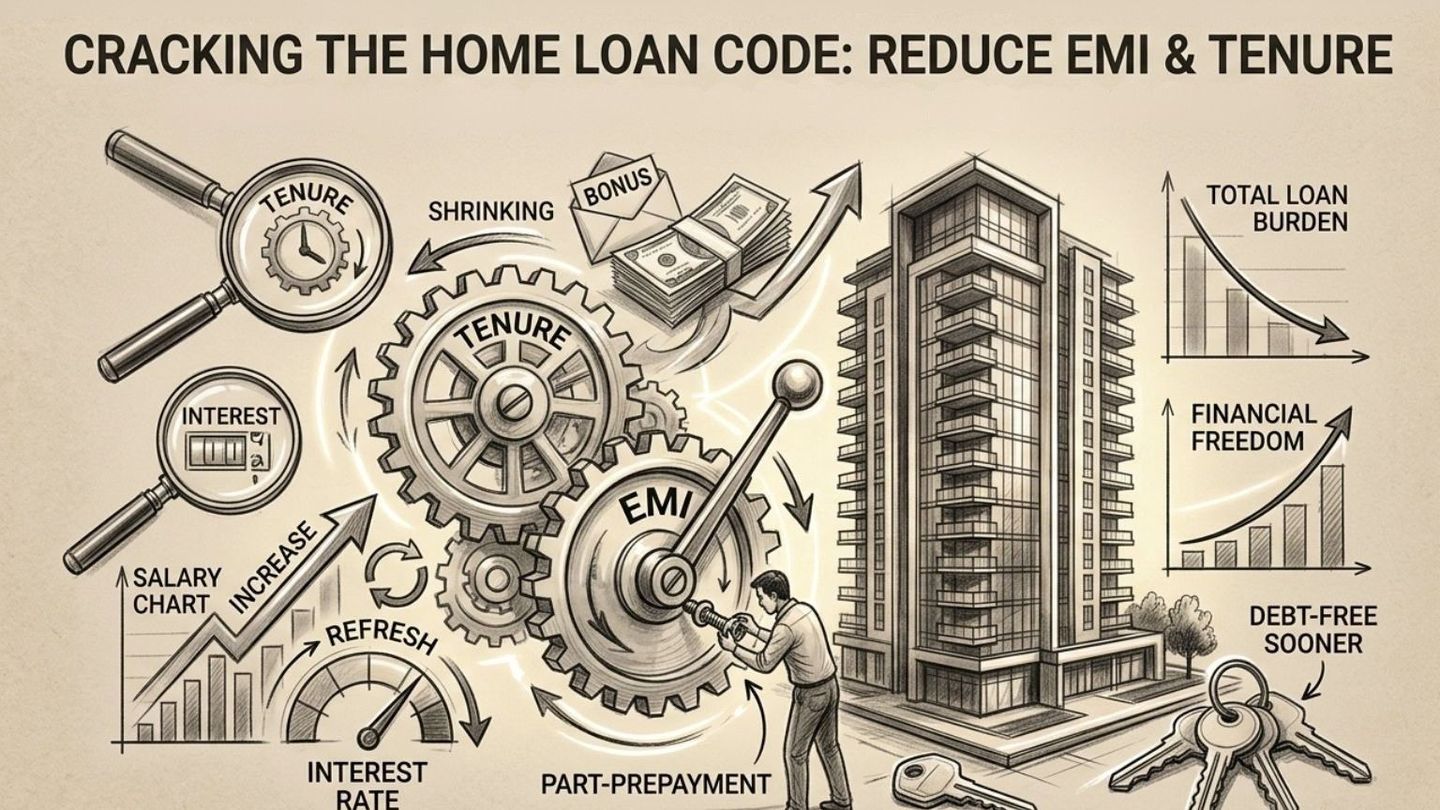
How to Reduce Your Home Loan EMI and Tenure?
Buying a home is a major financial milestone. For most homebuyers, it also means taking on a Home Loan that can run for 15, 20, or even 30 years. While a longer tenure can make the monthly EMI more manageable, it also means paying interest for a much longer period. Over time, the interest component can add significantly to the total cost of the home.
The good news is that your original Home Loan tenure doesn't have to match your actual repayment period. With the right financial strategy, you can reduce your outstanding principal, save on interest, and become debt-free sooner. Here are some practical ways to manage your Home Loan more effectively.
Start with the right loan tenure.
The tenure you choose when taking a home loan significantly affects your overall cost. A longer tenure means a lower monthly EMI but a higher total interest outgo. A shorter tenure works the other way around: the EMI is higher, but you repay the loan faster and save substantially on interest.
For instance, many people opt for a 25-year loan because the monthly payments are smaller and feel more manageable. But as their income grows over the years, they can increase their payments or pay off extra whenever they can, rather than sticking to the original schedule.
The objective should be to choose a tenure that keeps the EMI comfortable without unnecessarily extending the loan.
Make part-prepayments whenever you have surplus funds.
One of the most effective ways to reduce your Home Loan burden is to make part-prepayments. Whenever you receive a bonus, incentive, tax refund, or other surplus income, consider using a portion of it to reduce the outstanding principal. This can have a powerful effect because interest is calculated on the outstanding loan amount. As the principal decreases, the interest component also decreases.
The earlier you prepay in the loan cycle, the greater the potential benefit because you avoid interest on that amount for the remaining period. However, don't use all your savings for prepayment. Maintain an adequate emergency fund and account for other important financial commitments before making a large payment.
Increase your EMI as your income grows.
Your EMI does not have to remain unchanged throughout the life of your Home Loan. As your salary, business income or other earnings increase, consider increasing your EMI periodically.
For instance, a borrower who receives regular increments could increase the EMI by 5–10% periodically, rather than letting the additional income be absorbed entirely by higher spending.
Even a relatively small EMI increase can significantly shorten the repayment period because the extra amount reduces the principal faster. This strategy can be particularly effective for younger borrowers who expect their income to grow over time.
Use annual bonuses and lump-sum income wisely.
A Home Loan is a long-term commitment, and even occasional lump-sum payments can make a meaningful difference. Instead of treating an annual bonus or unexpected surplus income entirely as disposable income, consider allocating a portion towards your Home Loan.
For example, you could divide an annual bonus between investments, lifestyle expenses, emergency savings, and loan prepayment. The objective is not necessarily to put every rupee of surplus income into the Home Loan. It is to consistently reduce the principal without compromising your broader financial plan.
Consider a Step-up EMI.
A Step-up EMI structure can help borrowers who expect their income to increase significantly over time. Under this arrangement, the initial EMI is relatively lower and increases periodically according to the loan structure.
This can make repayment more manageable during the early years of your career while allowing you to pay higher EMIs as your income rises. However, borrowers should be careful when opting for this structure. The future EMI should remain affordable even under less favorable circumstances. A higher future income should be an expectation supported by your career or business trajectory, not an assumption.
Look at refinancing when interest rates fall.
Interest rates can change over the life of a Home Loan. If the interest rate on your existing loan is significantly higher than current rates, it may be worth evaluating a Home Loan balance transfer or refinancing.
A lower interest rate can reduce your overall interest cost and, depending on the new loan structure, potentially help you repay the loan faster. But don't base refinancing on the interest rate alone. Before switching, consider the outstanding principal, remaining tenure, processing fees, transfer charges, and other costs. Potential interest savings should be meaningfully higher than the cost of refinancing.
Don't automatically reduce your EMI after a prepayment.
This is an important decision that many borrowers overlook. After making a significant prepayment, lenders may offer the choice of reducing the EMI or reducing the loan tenure.
If your monthly cash flow lets you keep paying the existing EMI, reducing the tenure is often more effective because you become debt-free sooner and save additional interest. If your priority is improving monthly cash flow, reducing the EMI may make more sense. The right choice therefore depends on your financial objectives.
Review your Home Loan every year.
Your financial situation today may be very different from when you first took the loan. Your income may have increased. Your expenses may have changed. Interest rates may have moved. You may have accumulated investments or received a significant bonus.
That is why you should review your home loan periodically. At least once a year, look at your outstanding principal, interest rate, remaining tenure, and EMI. Then ask yourself whether you can increase your EMI, prepay, or explore a better interest rate.
Regular reviews can prevent you from staying on an expensive repayment schedule simply because it was the one you originally selected.
Use tax benefits, but don't borrow just for tax savings.
Home Loans can provide tax benefits subject to the applicable tax laws and the tax regime you follow. These benefits can reduce your effective borrowing cost. However, tax savings should not become a reason to retain a large loan unnecessarily.
Paying ₹1 of interest to save a fraction of that amount in taxes does not make financial sense on its own. Your decision to prepay should therefore consider the Home Loan interest rate, available tax benefits, alternative investment opportunities, and your overall financial position.
The key is consistency
Reducing a Home Loan is not necessarily about making one large payment. For many borrowers, the bigger impact comes from doing several things consistently, choosing an appropriate tenure, increasing the EMI as income rises, making periodic prepayments, and reviewing the loan regularly.
For example, a borrower who starts with a 20-year loan could significantly shorten the repayment period by increasing the EMI every few years and making occasional lump-sum prepayments. The result is not just a shorter loan. It can also substantially reduce the total interest paid over the life of the loan.
Should you focus on reducing EMI or reducing tenure?
This ultimately depends on your financial objective.
- If your current cash flow is under pressure, reducing the EMI can provide immediate relief.
- If your cash flow is comfortable and your priority is to become debt-free, maintaining a higher EMI and reducing the tenure is generally more efficient.
The important thing is to avoid looking at the EMI in isolation. A lower EMI may appear attractive, but if it comes with a significantly longer tenure, the total interest paid could be much higher.
Final Word
A Home Loan should help you buy your home without compromising your long-term financial stability. The goal, therefore, is not simply to find the lowest possible EMI. It is to find the right balance between monthly affordability, total interest cost, liquidity and the time required to become debt-free.
As your financial position improves, use that improvement strategically. Increase your EMI, make prepayments, and reassess your loan periodically. Because the smartest Home Loan is not necessarily the one with the lowest EMI. It is the one that allows you to own your home with the lowest sustainable financial burden.
FAQs
Can I reduce both my Home Loan EMI and tenure?
Usually, reducing the tenure means paying a higher EMI. However, part-prepayments can reduce the outstanding principal, giving you the option to lower the EMI or shorten the tenure. If you can afford your existing EMI, shortening the tenure generally saves more interest.
Is it better to prepay a Home Loan or invest the surplus money?
There is no universal answer. Compare the effective cost of your Home Loan with the expected, risk-adjusted return from the investment. Also consider liquidity, taxes, and your risk appetite before deciding.
Does increasing EMI reduce Home Loan interest?
Yes. Increasing the EMI can speed up principal repayment, reducing the period for which interest is charged and lowering the total interest paid.
How often should I increase my Home Loan EMI?
There is no fixed rule. Many borrowers can consider reviewing their EMI annually or whenever their income increases materially. The increase should remain comfortable even after accounting for other financial commitments.
Is a shorter Home Loan tenure always better?
Not necessarily. A shorter tenure reduces total interest but results in a higher EMI. If the higher EMI significantly affects your emergency savings, investments, or other financial obligations, a slightly longer tenure combined with periodic prepayments may be a better strategy.