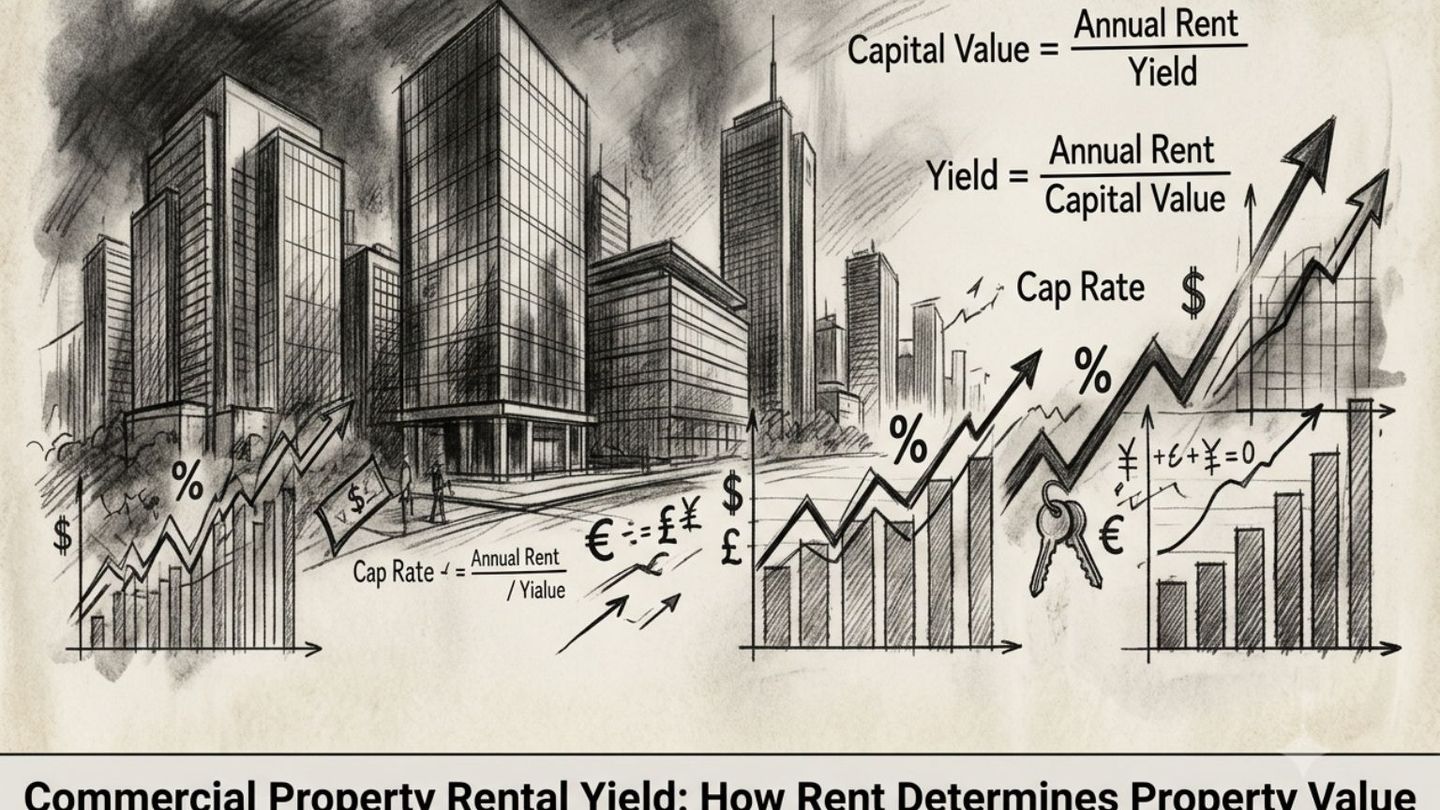
Commercial Property Rental Yield: How Rent Determines Property Value?
When a commercial property is offered as: “6% yield at ₹115 per sq. ft. rent” the investor is effectively being told that the property’s capital value is derived by capitalising its rental income at 6%. The basic relationship is: Capital Value = Annual Rental Income ÷ Rental Yield. Therefore, if the rent is ₹115 per sq. ft. per month and the required yield is 6%: ₹115 × 12 ÷ 6% = ₹23,000 per sq. ft.
So, the property’s value comes out to ₹23,000 per sq. ft. This becomes even more interesting when the lease contains rental escalations. If rent increases by 15% after three years, the rent becomes ₹132.25 per sq. ft. per month. If the market continues to value the property at a 6% yield, its implied value becomes: ₹132.25 × 12 ÷ 6% = ₹26,450 per sq. ft.
The property has therefore appreciated from ₹23,000 to ₹26,450 per sq ft, a 15% capital appreciation, purely because the rental income increased by 15%. This is the fundamental relationship between rent, yield and capital value in commercial real estate.
What Does “Available at 6% Yield” Actually Mean?
In residential real estate, we usually look at the property price first and then figure out the rental yield. In commercial real estate, it’s often the opposite: the property is shown based on its rent and yield.
For example:
- Monthly rent: ₹115/sq. ft.
- Annual rent: ₹1,380/sq. ft.
- Market yield: 6%
The implied capital value is: ₹1,380 ÷ 6% = ₹23,000/sq. ft.
So when a broker or developer says: “This is a 6% yielding property at ₹115 rent.” The underlying mathematics is: “At ₹115 rent, a 6% yield implies a capital value of ₹23,000/sq. ft.” This is essentially an income-capitalisation approach to valuation. In institutional real estate valuation, the capitalisation rate is generally linked to Net Operating Income and asset value, reflecting factors such as income stability, tenant quality, market demand, and risk.
The Basic Formula
The simplified commercial property formula is: Capital Value = Annual Rent ÷ Yield or Yield = Annual Rent ÷ Capital Value. For a property quoted on a per-square-foot basis: Capital Value per sq. ft. = Monthly Rent × 12 ÷ Yield.
Example:
Rent = ₹115/sq. ft./month
Annual rent: ₹115 × 12 = ₹1,380/sq. ft./year
At 6% yield: ₹1,380 ÷ 0.06 = ₹23,000/sq. ft.
Therefore:₹115 rent at 6% yield = ₹23,000/sq. ft. implied value
Why the Yield Matters So Much?
Yield is basically the return the market expects for owning that rental income. If the market yield is 6%, every ₹1 of annual rent is capitalised at: 1 ÷ 6% = 16.67 times.
This is sometimes called the capitalisation factor or Years’ Purchase.
Therefore: ₹1,380 annual rent × 16.67 = ₹23,000
The relationship is inverse:
Lower yield → Higher property value
Higher yield → Lower property value
For example:
Annual Rent | Yield | Implied Value |
₹1,380 | 5.0% | ₹27,600 |
₹1,380 | 5.5% | ₹25,091 |
₹1,380 | 6.0% | ₹23,000 |
₹1,380 | 6.5% | ₹21,231 |
₹1,380 | 7.0% | ₹19,714 |
The rent has not changed. Only the required yield has changed. Yet the implied capital value changes significantly.
The Impact of Rental Escalation
Now consider a common commercial lease structure.
Initial rent: ₹115/sq. ft./month
Escalation: 15% after 3 years
The new rent becomes: ₹115 × 1.15 = ₹132.25/sq. ft./month
Annual rent: ₹132.25 × 12 = ₹1,587/sq. ft.
If the market yield remains at 6%: ₹1,587 ÷ 6% = ₹26,450/sq. ft.
The value has therefore moved from: ₹23,000 → ₹26,450
Capital appreciation: ₹26,450 ÷ ₹23,000 – 1 = 15%
The key insight: If the yield remains unchanged, the percentage increase in capital value matches the percentage increase in rent. A 15% rent escalation creates 15% capital appreciation.
The 4-Year Lock-In: Why It Matters?
Suppose the property has a 4-year lock-in and the rent escalates by 15% after Year 3. The rental profile would look like this:
Year | Monthly Rent | Annual Rent |
Year 1 | ₹115.00 | ₹1,380 |
Year 2 | ₹115.00 | ₹1,380 |
Year 3 | ₹115.00 | ₹1,380 |
Year 4 | ₹132.25 | ₹1,587 |
The lock-in period gives you certainty about rental income, and the escalation sets a clear increase for future rent. But investors should know the difference between rent increases written into the contract and general market rent growth. A 15% rent increase written into the lease is valuable, but the resale value will still depend on things like the market yield, lease quality, tenant profile, and how reliable the income is.
What Happens If You Sell After Three Years?
Assume you buy today at: ₹23,000/sq ft. You hold the property for three years. At the end of Year 3, the rent increases by 15% to: ₹132.25/sq. ft./month.
Now suppose the buyer is willing to accept the same 6% yield. The exit value becomes ₹132.25 × 12 ÷ 6% = ₹26,450/sq. ft.
Therefore: Purchase Value ₹23,000/sq. ft.
Exit Value ₹26,450/sq. ft.
Capital Appreciation ₹3,450/sq. ft. at 15% appreciation
But There Is More Than Capital Appreciation
The investor has also received rent during the holding period. For simplicity, assume the property is rented for all three years at ₹115/sq. ft.
Annual rent: ₹1,380/sq. ft.
Three-year rental income: ₹ 1,380 × 3 = ₹4,140/sq. ft.
Capital appreciation: ₹26,450 – ₹23,000 = ₹3,450/sq. ft.
So, before you factor in taxes, transaction costs, maintenance, or financing:
Rental income = ₹4,140
Capital appreciation = ₹3,450
Total economic gain = ₹7,590/sq. ft.
Against an initial value of ₹23,000/sq. ft., this represents approximately 33% cumulative return over three years. However, this isn’t a 33% annual return. The yearly return would be lower, and it’s best to calculate it using the actual timing of rent payments and the sale.
What If the Yield Changes?
This is one of the most important ideas in commercial real estate investing. The exit value depends on both rent and yield. Suppose the Year 3 rent is ₹132.25/sq ft./month.
Scenario 1: Yield remains at 6%
Exit value: ₹132.25 × 12 ÷ 6% = ₹26,450
Capital appreciation: 15%
Scenario 2: Yield compresses to 5.5%
Exit value: ₹1,587 ÷ 5.5% = ₹28,855
Capital appreciation: 25.5%
The investor benefits from two factors: 15% rent growth + yield compression
Scenario 3: Yield increases to 6.5%
Exit value: ₹1,587 ÷ 6.5% = ₹24,415
Capital appreciation: 6.15%
So even though rent increased by 15%, the capital value increased by only about 6.15%.
The Commercial Real Estate Return Equation
This leads to a very useful framework: Capital Appreciation = Rental Growth + Yield Movement. Not literally as a simple addition, because the two effects interact mathematically, but conceptually these are the two major drivers. The exact relationship is: Exit Value = Exit Rent ÷ Exit Yield
Therefore:
Higher rent → Higher value
Lower yield → Higher value
Higher yield → Lower value
That’s why two commercial properties with the same rent can have very different values. The market might give a lower yield to a property with:
- Better tenant
- Longer lease
- Stronger location
- Better building quality
- Better liquidity
- Lower vacancy risk
- Stronger rental growth prospects
The Most Important Question: 6% Yield, But on What Basis?
When evaluating a commercial property, never stop at the headline: “6% yield.” Ask: What rent is being used?
Is it:
- Current rent?
- Contractual rent?
- Escalated rent?
- Market rent?
- Gross rent?
- Net rent?
What value is being used? Is the yield calculated on:
- Basic property price?
- All-in acquisition cost?
- Price including GST?
- Price including stamp duty and registration?
- Price including fit-out and other charges?
Who bears the expenses? You should also understand:
- CAM
- Property tax
- Insurance
- Maintenance
- Vacancy
- Leasing costs
- Brokerage
Institutional valuation typically focuses on NOI rather than headline gross rent.
A ₹10 Crore Example
Let’s make the calculation easier to understand at an actual investment level. Suppose a commercial property is priced at ₹10 crore. At a 6% yield, the implied annual rent is ₹10 crore × 6% = ₹60 lakh
Monthly rent: ₹60 lakh ÷ 12 = ₹5 lakh
Now assume rent increases by 15% after three years.
New annual rent: ₹60 lakh × 1.15 = ₹69 lakh
If the exit yield remains 6%: ₹69 lakh ÷ 6% = ₹11.50 crore
Therefore: Purchase value = ₹10 crore
Exit value = ₹11.50 crore
Capital appreciation = ₹1.50 crore
Capital appreciation = 15%
The investor has additionally received rental income during the holding period.
Why Lock-In and Escalation Should Be Analysed Together?
Don’t judge a commercial property just by today’s rent. The lease structure is important too. For example, compare these two properties:
Property A
- 6% yield
- 4-year lock-in
- 15% escalation after 3 years
Property B
- 6.5% yield
- 1-year lock-in
- No contractual escalation
Property B has the higher headline yield. But Property A may offer stronger income visibility and a better growth profile. So, instead of just asking, “Which property has the higher yield?” you should ask, “Which property offers the best risk-adjusted total return during my investment period?”
Rental Yield Is Not the Same as IRR (Internal Rate of Return)
This distinction is critical. A 6% rental yield does not mean the investor earns a 6% IRR. Why? Because the investor may receive:
- Rental income every month
- Rental escalation
- Capital appreciation
- Sale proceeds
- Acquisition costs
- Selling costs
The timing of each cash flow matters. Therefore, once you know the complete cash-flow schedule, XIRR is a better measure of the investor’s actual annualised return. For a commercial property investment, the hierarchy should therefore be: Yield → Rental Cash Flow → Capital Appreciation → Total Return → XIRR
A Simple Commercial Property Investment Framework
Before buying a pre-leased commercial property, calculate these seven numbers:
- All-in Acquisition Cost- Not just the quoted BSP.
- Current Rent- Actual contractual rent.
- Initial Yield- Annual Rent ÷ All-in Cost
- Rental Escalation- When does the rent increase and by how much?
- Lock-In- How long is the income contractually protected?
- Exit Yield- What yield can reasonably be assumed when you sell?
- XIRR- What is the annualised return considering all cash flows?
This framework gives you a far better picture than simply asking: “What is the rental yield?”
Final Takeaway
Commercial real estate is fundamentally an income-producing asset. When a property is quoted at a 6% yield, you can use the yield to reverse-engineer its implied capital value.
In our example: ₹115 rent × 12 ÷ 6% = ₹23,000/sq. ft.
After a 15% rent escalation: ₹132.25 rent × 12 ÷ 6% = ₹26,450/sq. ft.
Therefore: 15% rent growth → 15% capital appreciation, assuming the exit yield remains unchanged.
Yield compression: If the yield compresses from 6% to 5.5%, the appreciation increases to approximately 25.5%. The buyer is now willing to accept only a 5.5% return on the same rental income.
Therefore: ₹1,587 ÷ 5.5% = ₹28,855/sq. ft.
You originally paid: ₹23,000/sq. ft. Your property is now worth: ₹28,855/sq. ft.
So, Capital appreciation = (₹28,855 − ₹23,000) ÷ ₹23,000 =25.5%
Yield expansion: If the yield expands to 6.5%, appreciation falls to approximately 6.15%. The buyer now demands a higher return of 6.5%.
Therefore: ₹1,587 ÷ 6.5% = ₹24,415/sq. ft.
Your original investment was: ₹23,000/sq. ft.
Therefore: Capital appreciation = (₹24,415 − ₹23,000) ÷ ₹23,000= 6.15%
That is the real engine behind commercial property valuation as rent determines income. Yield determines the multiple. Together, they determine capital value. And for the investor, the final question is not simply “What is the yield?” It is: “What will my total return and XIRR be, given the rent, escalation, lock-in, acquisition cost and exit yield?” That analysis turns a commercial property purchase into an investment decision.
FAQ's
What does a 6% rental yield mean in commercial real estate?
A 6% rental yield means that the annual rental income represents 6% of the property’s capital value, based on the yield methodology being used. For example, if a commercial property generates rent of ₹115 per sq. ft. per month, its annual rent is ₹1,380 per sq. ft. At a 6% yield, the implied capital value would be ₹1,380 ÷ 6%, or ₹23,000 per sq. ft.
How do I calculate the price of a commercial property from rent?
The basic formula is Capital Value = Annual Rent ÷ Rental Yield. For example, if the monthly rent is ₹115 per sq. ft., the annual rent is ₹1,380 per sq. ft. At a 6% yield, the implied value is ₹1,380 ÷ 0.06 = ₹23,000 per sq. ft. This is why commercial properties are often quoted in terms of rental yield.
Does a 15% rent escalation automatically mean 15% capital appreciation?
Not necessarily. A 15% rent escalation will result in approximately 15% capital appreciation if the exit yield remains unchanged. For example, if rent increases from ₹115 to ₹132.25 per sq. ft. per month and the property continues to trade at a 6% yield, the value increases from ₹23,000 to ₹26,450 per sq. ft., representing 15% appreciation. If market yields change, capital appreciation will change.
What happens if the yield falls from 6% to 5.5%?
A fall in yield, or yield compression, generally increases the capital value of a commercial property. If the rent after escalation is ₹132.25 per sq. ft. per month, the annual rent is ₹1,587. At a 5.5% yield, the implied value becomes approximately ₹28,855 per sq. ft., compared with ₹23,000 per sq. ft. initially. This represents approximately 25.5% capital appreciation.
What happens if the yield rises from 6% to 6.5%?
A higher required yield generally puts downward pressure on capital values. Using the same escalated rent of ₹132.25 per sq. ft. per month, the annual rent is ₹1,587. At a 6.5% yield, the implied value is approximately ₹24,415 per sq. ft. Therefore, despite the 15% increase in rent, the property would have appreciated by only around 6.15% from the original ₹23,000 per sq. ft. value.
Is the quoted 6% yield calculated on gross rent or net rent?
Check this specifically before comparing commercial properties. A quoted yield may be based on gross contractual rent, while a more rigorous investment analysis should consider the income available to the owner after relevant operating expenses. Investors should therefore ask whether the quoted yield is gross or net, and understand who bears costs such as CAM, property tax, insurance, maintenance, and other operating expenses.
Does the lock-in period affect the value of a commercial property?
Yes. A lock-in period provides greater visibility of rental income and can reduce near-term vacancy risk. However, its value depends on the tenant's quality, remaining lease term, rent, escalation clauses, exit provisions, and other lease conditions. A four-year lock-in with a strong tenant and contractual rental escalation can provide considerably greater income visibility than a similar property with a shorter lock-in.
If rent increases after three years, should I use the higher rent to calculate the Year 3 sale value?
The exit valuation should generally reflect the income stream that the buyer is acquiring, including contractual rent that becomes payable under the lease. Therefore, if the property is sold after the 15% escalation has taken effect, the higher rent can form the basis for calculating the capital value. The fundamental principle is Exit Value = Forward Rental Income ÷ Exit Yield, although the precise treatment depends on the timing of the transaction and lease terms.
Is rental yield the same as return on investment?
No. Rental yield measures the income generated by the property relative to its value or investment cost. Total investment return can also include capital appreciation, transaction costs, taxes, financing costs and other cash flows. For an investor holding a property for several years and receiving rent before eventually selling it, IRR or XIRR provides a more complete measure of annualised return because it accounts for the timing of cash flows.
Is a higher rental yield always better?
No. A higher yield can sometimes indicate higher risk. A property offering a 7% yield may have a weaker tenant, shorter lease, higher vacancy risk, lower liquidity or limited rental growth. In comparison, a 6% yielding property may have a stronger tenant, longer lock-in and better rental growth prospects. Commercial property should therefore be evaluated on risk-adjusted total return, rather than headline rental yield alone.
What is yield compression?
Yield compression occurs when the market’s required yield falls. For example, if the market yield moves from 6% to 5.5%, the same rental income is capitalised at a higher value. This can create capital appreciation even if the rent itself has not increased. Yield compression is therefore one of the two major drivers of commercial property appreciation, the other being rental growth.
Can a commercial property appreciate even if rent does not increase?
Yes. Capital appreciation can occur through yield compression even when rental income remains unchanged. For example, annual rent of ₹1,380 per sq. ft. capitalised at 6% produces a value of ₹23,000 per sq. ft. If the market yield subsequently falls to 5.5%, the same rental income implies a value of approximately ₹25,091 per sq. ft. The property would therefore appreciate by about 9.1% without any rent increase.
What is the difference between rental yield and cap rate?
The terms are often used interchangeably in commercial real estate conversations, but they can have different meanings depending on the methodology. A simple rental yield may be calculated using gross contractual rent, whereas a capitalisation rate is more appropriately applied to Net Operating Income (NOI). When comparing properties, it is therefore important to establish exactly what income and expenses the quoted yield includes.
Should GST, stamp duty and other acquisition costs be included when calculating rental yield?
For a genuine investment analysis, investors should consider the actual capital deployed, not just the headline property price. Depending on the transaction, this may include GST (where applicable), stamp duty, registration, brokerage, fit-out costs, and other acquisition expenses. Calculating the yield on the all-in investment cost provides a more realistic picture of the investor’s actual return.
What is the best way to evaluate a pre-leased commercial property?
A pre-leased commercial property should not be evaluated only on its headline yield. The investor should analyse the all-in acquisition cost, current rent, net yield, tenant quality, lock-in period, remaining lease term, rental escalation, vacancy risk, operating expenses, exit yield and expected sale value. Finally, bring all cash flows together to calculate the XIRR, which provides a more meaningful measure of the investor’s annualised return.
What is the most important thing to remember when evaluating a commercial property on rental yield?
The most important principle is that rent and yield work together to determine capital value. A property generating higher rent is worth more, all else being equal, while a property trading at a lower yield is also worth more for the same rental income. Therefore, the right investment question is not simply, “What is the rental yield?” but rather, “What rental income will the property generate, how will that income grow, at what yield can it be sold, and what XIRR will I ultimately earn?”