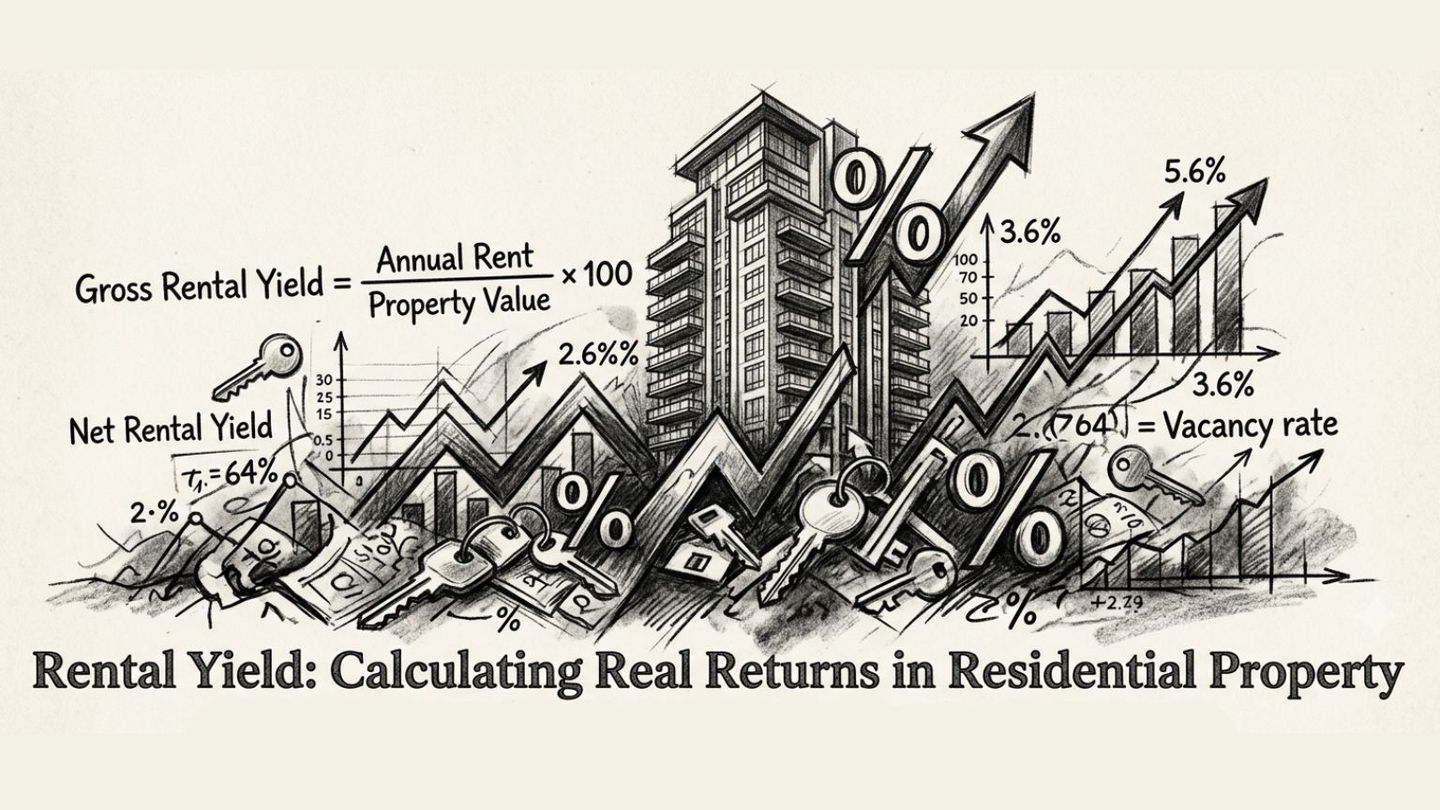
Rental Yield: How to Calculate the Real Return on Your Residential Property
Rental yield is one of the simplest ways to measure how much income a property generates relative to the money invested. Yet, it is also one of the most misunderstood metrics in real estate.
A property may be advertised as offering a 4% rental yield. Still, once you account for maintenance, vacancy, property tax, brokerage, furnishing and other ownership costs, the actual return may be significantly lower. For an investor, the right question isn't: “What rent can I get?” It is: “What rental yield am I actually earning on my total investment?”
What Is Rental Yield?
Rental yield is the annual return a property generates from rental income, expressed as a percentage of the property’s value or investment cost. It helps answer a basic question: “If I invest ₹100 in this property, how much rental income does it generate every year?”
For example:
Property | Value | Monthly Rent | Annual Rent | Gross Yield |
Property A | ₹1 Cr | ₹25,000 | ₹3 Lakh | 3.0% |
Property B | ₹2 Cr | ₹60,000 | ₹7.2 Lakh | 3.6% |
Property C | ₹3 Cr | ₹75,000 | ₹9 Lakh | 3.0% |
Property B generates the highest rental yield despite having the highest ticket size among the first two properties.
The Basic Rental Yield Formula
The most commonly used formula is: Gross Rental Yield = Annual Rental Income ÷ Property Value × 100
Suppose: Property value = ₹2 crore
Monthly rent = ₹60,000
Annual rent: ₹60,000 × 12 = ₹7,20,000
Therefore: Rental Yield = ₹7,20,000 ÷ ₹2,00,00,000 × 100 = 3.6%
This is the property’s gross rental yield.
But What Property Value Should You Use?
This is where rental yield calculations often go wrong. Should you calculate the yield on agreement value? Purchase price? Current market value? or total acquisition cost? The answer depends on what you are trying to measure. For evaluating a new purchase, Use total acquisition cost. This should ideally include property price, stamp duty, registration, brokerage, parking, PLC, club charges, initial furnishing/interiors and other mandatory charges.
For example: Property price = ₹2 crore
Stamp duty & registration = ₹12 lakh
Brokerage = ₹2 lakh
Furnishing = ₹6 lakh
Total investment = ₹2.20 crore
If annual rent is ₹7.2 lakh: Yield = ₹7.2 lakh ÷ ₹2.20 crore × 100 = 3.27%
The advertised 3.6% yield has now become 3.27%.
Gross Rental Yield vs Net Rental Yield
This distinction is critical.
Gross Rental Yield: It ignores ownership expenses.
Gross Yield = Annual Rent ÷ Property Value × 100
Net Rental Yield: It considers the actual income left after property-related expenses.
Net Yield = Net Annual Rental Income ÷ Total Investment × 100. Net annual rental income can be calculated as: Annual Rent – Vacancy Loss – Maintenance – Property Tax – Repairs – Property Management – Other Expenses.
Example: Calculating Net Rental Yield
Consider a ₹2 crore apartment.
Monthly rent = ₹60,000
Annual rent: ₹60,000 × 12 = ₹7.2 lakh
Now assume:
Expense | Annual Cost |
Maintenance | ₹60,000 |
Property tax | ₹20,000 |
Repairs | ₹15,000 |
Vacancy allowance | ₹30,000 |
Property management | ₹15,000 |
Total | ₹1,40,000 |
Net rental income: ₹7.2 lakh – ₹1.4 lakh = ₹5.8 lakh
If total investment is ₹2.20 crore:
Net Rental Yield = ₹5.8 lakh ÷ ₹2.20 crore × 100 = 2.64%
So the same property can have: Headline gross yield: 3.6% but Actual net yield: 2.64%. That is a very different investment proposition.
Don’t Forget Vacancy
A property does not necessarily remain rented for 12 months every year. There may be:
- Tenant turnover
- Finding a new tenant
- Renovation between tenants
- Lock-in periods
- Market downturns
- Delays in tenant replacement
If monthly rent is ₹60,000 and the property remains vacant for one month, annual actual rent becomes: ₹60,000 × 11 = ₹6.6 lakh, instead of ₹7.2 lakh. Your gross yield therefore falls from 3.6% → 3.3%. This is why investors should consider a realistic vacancy assumption rather than simply multiplying monthly rent by 12.
Rental Yield on Current Market Value
There is another important calculation. Suppose you bought a property for ₹1 crore. Today, it is worth ₹2 crore. You are receiving ₹6 lakh in annual rent.
Your historical yield based on purchase price is: ₹6 lakh ÷ ₹1 crore = 6%
But your yield on today’s market value is: ₹6 lakh ÷ ₹2 crore = 3%
Both numbers are mathematically correct but they answer different questions.
Yield on purchase price: “What return am I earning on the money I originally invested?”
Yield on current market value: “What return am I earning today on the capital currently tied up in this property?”
For an investment decision, particularly whether to hold or sell, the second calculation can be more relevant.
Rental Yield vs Capital Appreciation
Don't view rental yield in isolation. Real estate returns generally come from two components:
- Rental Income- The cash flow the property generates.
- Capital Appreciation- The increase in the property’s market value. For example: Property value = ₹2 crore, Annual rent = ₹6 lakh and Annual appreciation = 8%
Approximate annual return: Rental Yield + Capital Appreciation
= 3% + 8%
= 11%
However, this is only a simplified framework. Taxes, transaction costs, vacancy, financing costs and the timing of cash flows can materially change the actual investor return.
Rental Yield and Home Loans
One of the biggest mistakes investors make is confusing rental yield with return on equity.
Suppose: Property value = ₹2 crore
Down payment = ₹50 lakh
Loan = ₹1.5 crore
If the property generates ₹7.2 lakh annual rent, the rental yield on the property is still: 3.6%. It does not become 14.4% simply because the investor invested only ₹50 lakh.
Leverage changes the investor’s return on equity, but rental yield itself is calculated against the property value or total investment, depending on the methodology being used. If the mortgage interest rate is significantly higher than the rental yield, the property may generate negative leveraged cash flow even with a positive rental yield.
A Better Way to Evaluate Rental Properties
Rental yield should ideally be treated as one input into the investment decision-not the decision itself. A better property investment analysis should consider:
- Property- Purchase price, Total acquisition cost, Current market value, Property type, Size and Location
- Rental- Monthly rent, Expected rent escalation, Vacancy, Tenant profile, Lease tenure
- Expenses- Maintenance, Property tax, Repairs, Brokerage, Property management, Insurance, Furnishing
- Financing- Loan amount, Interest rate, EMI, Loan tenure
- Investment- Rental yield, Capital appreciation, Cash-on-cash return, IRR/XIRR, Exit value, Transaction costs
This gives a much more complete picture of the investment.
A Simple Rental Yield Calculator
You can calculate rental yield using this simple framework:
Step 1: Calculate Annual Rent
Monthly Rent × 12
Step 2: Calculate Gross Yield
Annual Rent ÷ Property Value × 100
Step 3: Calculate Net Rental Income
Annual Rent – Vacancy – Maintenance – Taxes – Repairs – Other Expenses
Step 4: Calculate Net Yield
Net Rental Income ÷ Total Investment × 100
Step 5: Compare Against Alternatives
Ask: Is the rental yield adequate for the price being paid? A 3% yield may be attractive for one property and unattractive for another depending on its expected appreciation, liquidity, location and risk.
What Is a “Good” Rental Yield?
There is no universal number. Rental yields vary significantly by city, micro-market, property type, ticket size, location, tenant demand and capital appreciation potential. Generally, expensive luxury residential properties tend to have lower rental yields because property prices can rise much faster than rents.
Commercial properties can sometimes offer higher yields, but they also come with different risks such as:
- Longer vacancy periods
- Tenant concentration
- Lease renewal risk
- Fit-out requirements
- Location-specific demand
Comparing a luxury apartment with a commercial asset purely on rental yield can be misleading.
The Most Important Number: Total Return
Rental yield tells you about income but doesn't tell you the full investment return. For a long-term investor, the more meaningful calculation is often: Total Return = Rental Income + Capital Appreciation – Costs. And when the timing of cash flows is important, the better metric is: IRR / XIRR. This becomes particularly relevant for under-construction properties where the investor makes multiple payments over several years.
A property generating a 3% rental yield today may still be an attractive investment if its location, product and demand fundamentals support strong appreciation. Conversely, a property offering a 5% rental yield may not be attractive if the underlying asset is losing value or becoming difficult to sell.
Conclusion
Rental yield is a starting point-not the finish line. The simple calculation: Annual Rent ÷ Property Value is useful for quickly comparing properties.
But serious investors should go one step further and calculate: Net Rental Yield = Net Annual Rental Income ÷ Total Investment. And ultimately evaluate: Rental Income + Capital Appreciation + Financing Impact + Costs + Exit Value
The real question is not: “What is the rental yield?” It is: “What return am I actually generating on the capital invested in this property, and is that return adequate for the risk?” That is the difference between buying a property for rent and investing in real estate with a return framework.
FAQ’s
Is rental yield calculated on property price or current market value?
Both can be used, but they answer different questions. For a new investment, total acquisition cost is generally more meaningful. For an existing property, yield on current market value helps assess whether the capital remains efficiently deployed.
Is 3% rental yield good?
It depends on the property, location, appreciation potential, liquidity and risk. Don't evaluate rental yield in isolation.
Does rental yield include appreciation?
No. Rental yield measures rental income. Capital appreciation is a separate component of total return.
What is better, higher rental yield or higher appreciation?
Neither is automatically better. The right investment depends on the investor’s objective, risk tolerance, holding period and expected total return.
Should maintenance be deducted from rental yield?
For gross yield, no. For net rental yield, yes.
Should vacancy be considered?
Yes. A realistic rental analysis should account for periods when the property is not generating rent.
Does EMI affect rental yield?
No. EMI does not change the property’s rental yield. However, interest and principal payments are critical when calculating the investor’s cash flow and return on equity.