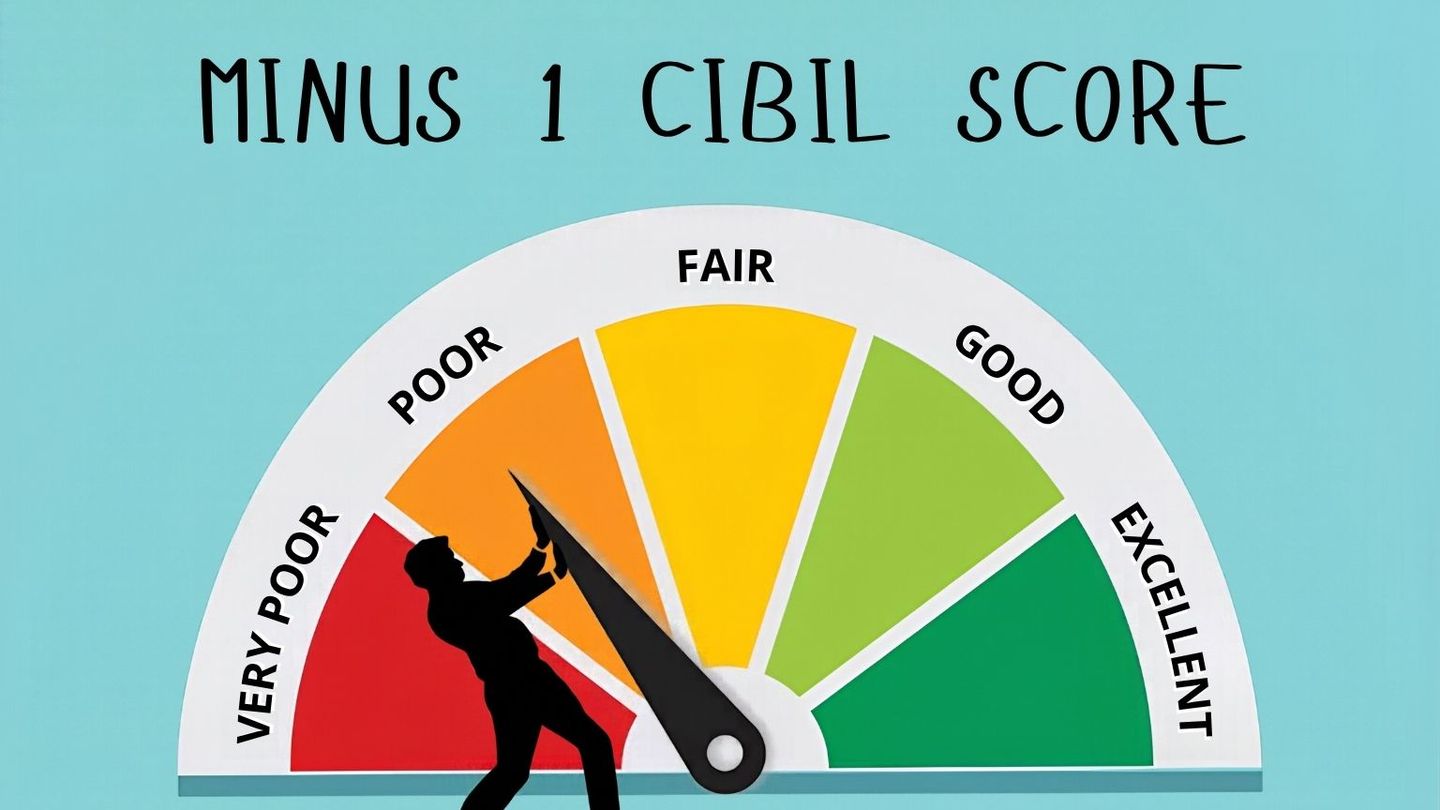
What Does a Minus 1 CIBIL Score Mean?
Having a good credit score usually makes it easier to borrow money. But what does it mean if your CIBIL report shows a score of - 1? For many people, this can be confusing. Does it mean their credit score is poor? Have banks rejected them? Can they still qualify for a home loan?
The answer is that a Minus 1 CIBIL score generally indicates that a conventional credit score is unavailable, rather than that the borrower has a poor credit history. The exact interpretation depends on the credit report and the status displayed.
For someone who has never taken a loan or used a credit card, this may mean there is insufficient credit history to assess repayment behaviour. However, if someone already has loans or credit cards, it is important to examine their report to understand why a score is unavailable. In this article, we explain what a -1 CIBIL score means, why it occurs, how it affects home loan eligibility and what you can do to establish or correct your credit profile.
What Is a CIBIL Score?
A CIBIL score is a three-digit number that summarises an individual's credit history and repayment behaviour. TransUnion CIBIL, one of India's credit information companies, generates it using information reported by banks and other credit institutions.
The conventional CIBIL score ranges from 300 to 900. Generally, a higher score indicates a stronger credit history and can improve the chances of a loan application being considered favourably. Lenders use credit scores and credit reports to assess an individual's lending risk.
They may also examine income, existing liabilities, employment or business stability, repayment capacity and other relevant factors before making a lending decision. It is important to understand that CIBIL does not approve or reject loans. The lender makes the final decision.
What Does a Minus 1 CIBIL Score Mean?
A -1 CIBIL score is commonly understood as an indication that a conventional numeric credit score is not available. In many cases, this reflects insufficient credit history or limited credit activity. CIBIL's official guidance explains that a score displayed as NA (Not Available) or NH (No History) is not inherently negative. These statuses may appear when an individual has no credit history, insufficient history to be scored, no recent credit activity or only supplementary credit cards without independent credit exposure.
The precise display may vary by report or credit product. Therefore, if your report specifically shows -1, review the accompanying status and details rather than assuming that it has the same meaning in every context.
The key distinction is that an unavailable score is not the same as a low score. A low score reflects an assessment of the available credit history, whereas a no-score status generally means that the information is insufficient to produce a conventional score.
Why Does Your CIBIL Score Show -1?
Several reasons may explain why your CIBIL report doesn't show a conventional numeric score.
- You Have Never Taken a Loan or Credit Card
This is one of the most common explanations. If you have never borrowed money through a bank or financial institution and have never held a credit card in your own name, there may be no repayment history available to evaluate.
For example, a young professional who has always paid expenses from their salary and savings may have a healthy financial position but no established credit history. Because credit scores are based on reported credit behaviour, a lack of borrowing history can make it difficult to generate a conventional score. - You Have an Insufficient Credit History
You may have taken a loan or obtained a credit card, but your credit history may still be too limited to generate a score. Lenders report credit information, and your available history may not yet provide enough information for the scoring system to generate a conventional score. However, CIBIL's current scoring methodology can assess consumers with less than six months of credit history. Therefore, a short credit history does not automatically mean that your score will be –1. - You Have Not Used Credit Recently
If you previously had loans or credit cards but haven't had recent credit activity, your report may not contain enough information for a conventional score. CIBIL identifies a lack of credit activity in the past couple of years as one possible reason for an NA/NH status. If this applies to you, review the account information and dates in your credit report before deciding what action to take. - You Have Only Supplementary Credit Cards
An add-on credit card issued against another person's primary credit card account may not establish independent credit exposure in your name. For instance, if you use an add-on card linked to your spouse's account, the primary account holder is generally responsible for the underlying credit facility. Consequently, using an add-on card alone may not establish the independent borrowing history needed to generate your own conventional score. - Your Existing Credit Accounts Are Missing From the Report
A no-score result should not automatically mean you lack borrowing history. If you have previously taken loans or held credit cards, check whether those accounts appear in your credit report. Credit institutions supply account information to CIBIL, and you may need to investigate errors or missing information. Verify your personal details, PAN, account ownership and repayment history. If information is missing or incorrect, contact the lender and raise a dispute with CIBIL where appropriate.
Is a -1 CIBIL Score Bad?
No. A –1 or no-score status is not automatically a negative credit assessment. Consider the following examples:
Borrower A: Has never taken a loan or credit card. The report shows no established credit history.
Borrower B: Has a credit score of 550 because their credit report reflects late repayments and other adverse credit behaviour.
Both borrowers may face questions when applying for credit, but for different reasons. Borrower A lacks an established repayment track record, while Borrower B has an existing credit history that may indicate higher credit risk.
This distinction matters because each case requires a different solution. Borrower A may need to establish a credit history, whereas Borrower B may need to address repayment issues and improve their existing credit profile. A no-score status should therefore not be interpreted as proof of financial strength or weakness. It means that the lender may have limited information about your credit behaviour.
Can You Get a Home Loan With a -1 CIBIL Score?
Yes, it may be possible to obtain a home loan with a -1 CIBIL score, but approval depends on the lender's credit policy and the applicant's overall financial profile. Some lenders may restrict lending to applicants without an established credit history. Others may assess the application using additional financial information. When evaluating a home loan application, lenders may consider:
- Income and repayment capacity: Whether your regular income or business cash flow can support the proposed EMI.
- Employment or business stability: The consistency of your income and financial position.
- Existing liabilities: Other loans, credit card balances and monthly financial obligations.
- Down payment: The amount of your own funds being contributed towards the property.
- Property details: The property value, documentation and other requirements relevant to the loan.
- Banking history: Account statements and other financial records that may help demonstrate financial discipline.
A high income and substantial down payment may strengthen an application, but neither guarantees approval. The lender must still be satisfied with the applicant's overall risk profile.
Does a -1 CIBIL Score Mean Your Home Loan Will Be Rejected?
Not necessarily. A lender may decline an application if its internal credit policy requires an established credit score. Another lender may consider applicants with limited credit histories, subject to its underwriting requirements.
If you are planning to purchase a property, ask prospective lenders whether they accept applicants with no established credit score before submitting multiple formal applications. Comparing lender policies in advance can help you avoid unnecessary credit enquiries and save time during the home-buying process.
How Can You Build Your CIBIL Score From -1?
If you have no established credit history, the objective is to create a record of responsible borrowing. You don't need unnecessary debt to build a credit score.
- Consider a Credit Card in Your Own Name
A suitable credit card can help establish an independent credit history if the issuer reports the account to CIBIL. Choose a card with manageable fees and a credit limit appropriate for your spending habits. Use it for routine expenses that you are able to comfortably afford, and pay the bill on time. If you are not eligible for a conventional credit card, you can ask your bank about suitable alternatives, including secured credit cards, where available. - Pay Every EMI and Credit Card Bill on Time
Repayment behaviour is an important factor in credit scoring. Once you start using credit, pay all dues by their respective deadlines. Automatic payments or reminders can help prevent missed payments. Avoid borrowing more than you can comfortably repay, even if a lender offers a higher credit limit. - Keep Credit Utilisation Under Control
Credit utilisation refers to the proportion of your available revolving credit that you use. For example, if your credit card limit is ₹1 lakh and your outstanding balance is ₹20,000, your utilisation is 20%. Keeping utilisation relatively low can sustain a healthier credit profile. Avoid routinely using most of your available credit limit, even if you pay the bill later. - Apply for Credit Selectively
Submitting several loan or credit card applications within a short period may result in multiple credit enquiries. Frequent applications can affect how lenders assess your credit profile. Compare eligibility requirements and available options before submitting formal applications. - Monitor Your Credit Report
Check your credit report periodically to confirm that your accounts and repayment details are being reported accurately. Look for incorrect overdue amounts, missing accounts, duplicate entries or loans that do not belong to you. If you identify a discrepancy, contact the relevant lender and initiate a dispute with CIBIL as appropriate. - Give Your Credit History Time to Develop
A credit score is generated from the credit information available to the bureau. A consistent repayment record may help build a scorable profile, but there is no guaranteed timeframe for reaching a particular score. Keep managing credit responsibly rather than focusing only on a specific number.
What If You Already Have a Home Loan but Your CIBIL Score Is -1?
This situation deserves closer attention. If you have an active home loan, car loan, personal loan, or credit card in your own name, review your report to understand why a conventional score is unavailable. Start by checking the following:
- Verify whether your loan accounts are listed. Confirm that the account details and ownership information are correct.
- Review your repayment history. Check whether recent payments and account updates appear correctly.
- Confirm your personal details. Errors in your PAN, name, or other identification information may complicate matching credit records.
- Contact your lender. Ask whether the account information has been reported to CIBIL and whether it needs correction.
- Raise a dispute if necessary. CIBIL can investigate reported discrepancies, but changes to account information generally require verification by the institution that supplied it.
Don't take a new loan to build a score before investigating why your existing borrowing history isn't reflected correctly.
How Does a -1 CIBIL Score Affect Your Interest Rate?
A -1 score does not automatically result in a higher home loan interest rate. However, without an established credit history, the lender may have limited ability to assess your repayment behaviour. Depending on its policies, the lender may approve the application on specified terms, request supplementary documentation or decline to offer credit. If you are eligible for a home loan, compare the complete terms offered by different lenders, including:
- The applicable interest rate and whether it is fixed or floating.
- Processing fees and other applicable charges.
- Loan tenure and EMI.
- Prepayment and foreclosure conditions.
- Any additional requirements associated with the loan.
The objective is to identify a suitable loan based on your overall financial circumstances rather than relying on your credit score alone.
Conclusion
A -1 CIBIL score can be confusing, especially when you are planning a major financial decision like buying a home. However, you shouldn't automatically treat it as a bad credit score. In many cases, it indicates insufficient information to generate a conventional numeric score. The next step is to establish whether you have no credit history, limited recent credit activity or an issue with how your existing accounts are reported.
If you have never borrowed, using suitable credit responsibly can help you build a credit profile over time. If you already have loans or credit cards, review your report and investigate any missing or inaccurate information before taking further action. The most important point is this: a -1 CIBIL score does not automatically mean that you are financially unreliable or ineligible for a home loan. Understanding why the score is unavailable and approaching lenders whose policies fit your circumstances can help you make a more informed borrowing decision.
FAQ's
Is -1 the same as a zero CIBIL score?
Not necessarily. CIBIL's conventional numeric score ranges from 300 to 900. A display of -1 may indicate that a conventional score is unavailable, depending on the report or product. Check the accompanying status and explanation in your report.
Can a person with no credit history get a home loan?
Yes, some lenders may consider applicants without an established credit history. Approval depends on the lender's policy, income, repayment capacity, property details and other underwriting requirements.
How long does it take to move from -1 to a numeric CIBIL score?
No fixed timeline applies to everyone. It depends on when eligible credit information is reported and whether there is sufficient information for the applicable scoring methodology to generate a score.
Will taking a personal loan immediately improve my CIBIL score?
Not necessarily. Taking a loan does not guarantee a higher score and creates a repayment obligation. Borrow only when you genuinely need it, and the repayments fit your budget.
Does having a high income guarantee a good CIBIL score?
No. Income and credit score measure different things. A person with a high income may have no established credit history, while someone with a moderate income may have a strong repayment record.
Can a -1 CIBIL score be corrected?
If the status reflects insufficient credit history, it may not require correction. If you already have credit accounts that are missing or incorrectly reported, contact the relevant lender and raise a dispute where appropriate.
Is a -1 CIBIL score the same as being a loan defaulter?
No. A no-score status does not by itself establish that someone has defaulted on a loan. To understand a borrower's repayment history, lenders must review the available credit report and other relevant information.
Disclaimer: This article is intended for general educational purposes only and does not constitute financial or lending advice. Credit reporting practices, scoring methodologies, eligibility requirements and loan terms may vary. Consult the relevant lender and refer to your latest CIBIL report for information specific to your circumstances.