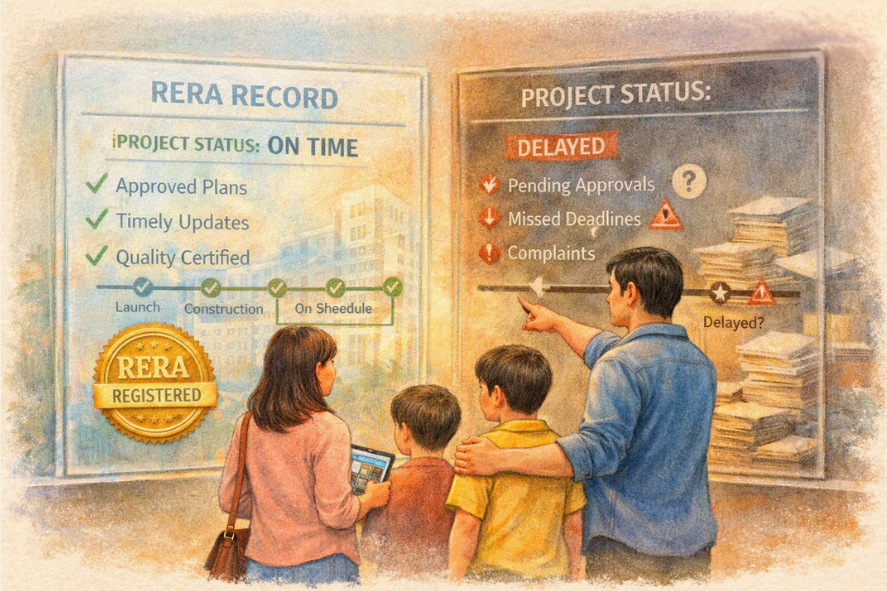
What Buyers Can Learn from a Developer’s RERA Track Record?
Many homebuyers use the RERA portal just to check if a project is registered. Registration is important, but it is only the first step in doing thorough research. The Real Estate (Regulation and Development) Act (RERA) has made Indian real estate more transparent by keeping a public record of every registered project. This helps buyers look at a developer’s track record instead of just trusting brochures or sales pitches. For anyone investing in an under-construction property, a developer’s RERA track record is one of the strongest indicators of execution capability and delivery reliability.
What Is a Developer’s RERA Track Record?
A developer’s RERA track record shows how all their registered projects have performed. By looking at past projects, buyers can see if the developer usually keeps their promises to customers. The RERA portal contains valuable information such as:
- Project registration details
- Promised possession dates
- Quarterly construction updates
- Project approvals
- Completion status
- Occupancy Certificates
- Changes made during construction
Viewed together, these details provide an objective assessment of a developer’s credibility.
Five Things Every Buyer Should Check
- Delivery Timeline- Did the developer complete previous projects within the committed timeline? Occasional delays may occur because of external factors, but repeated delays across multiple developments should encourage further investigation.
- Construction Progress- Every registered project must periodically update construction progress. Consistent updates indicate transparency and regulatory compliance. Large gaps in reporting may suggest weaker governance.
- Completion and Occupancy- Check whether previous projects received Completion Certificates (CC) and Occupancy Certificates (OC). Projects that achieve timely completion demonstrate stronger execution capability.
- Consistency Across Projects- Instead of evaluating only one project, review several completed and ongoing developments. A consistent delivery record is generally a stronger indicator than one exceptional project.
- Transparency and Compliance- Developers who keep sharing all the needed documents and updates usually show they are more responsible. Transparency often reflects organisational discipline.
Why This Information Matters?
When buying an under-construction apartment, you’re investing years before taking possession. The biggest risk is not always pricing, it is execution. A developer who has delivered on time, provided regular updates, and completed projects before is much less likely to have problems finishing your home. Past performance cannot guarantee future results, but it provides valuable evidence for making informed investment decisions.
RERA Alone Is Not Enough!
RERA provides helpful information, but you should not rely only on whether a project is registered. A complete due diligence process should also evaluate:
- Developer financial strength
- Construction quality
- Contractor credentials
- Land ownership
- Legal approvals
- Location fundamentals
- Infrastructure growth
- Project density
- Floor plans
- Pricing compared to competing developments
- Future resale demand
- Rental potential
Professional investors analyse multiple parameters before making investment decisions. Homebuyers should take the same careful approach.
How prOPIUM Evaluates Developers?
At prOPIUM, we believe you should buy a property based on real data, not just on marketing. Our research combines RERA disclosures with multiple additional parameters, including:
- Developer delivery history
- Construction quality
- Legal due diligence
- Pricing intelligence
- Market demand
- Infrastructure developments
- Investment potential
- Long-term appreciation prospects
Instead of asking only, “Is this project RERA registered?”, we ask a more important question: Has this developer consistently delivered what they promised? This difference can separate a smart investment from a costly mistake.
Conclusion
RERA has made Indian real estate much more open and transparent. However, smart buyers don’t stop at checking whether a project is registered. They study a developer’s history, compare previous deliveries, analyze execution capability, and make decisions based on facts. Because in real estate, trust should be earned through performance not promises.
FAQs
Is checking RERA registration enough before buying a property?
No. Registration confirms regulatory compliance, but buyers should also review the developer’s delivery history, legal approvals, construction quality, and financial strength.
How can I check a developer’s RERA track record?
Visit the relevant state’s RERA portal, search for the developer’s registered projects, and review possession timelines, quarterly updates, approvals, and completion status.
Can RERA guarantee timely possession?
No. RERA improves accountability and provides legal remedies, but it does not guarantee that every project will be delivered on schedule.
Why should I review previous RERA projects?
Past projects reveal whether a developer has consistently met commitments, providing insight into execution capability and transparency.
What other factors should I evaluate besides RERA?
Buyers should assess location, pricing, construction quality, developer reputation, project density, legal approvals, infrastructure, resale demand, and rental potential.