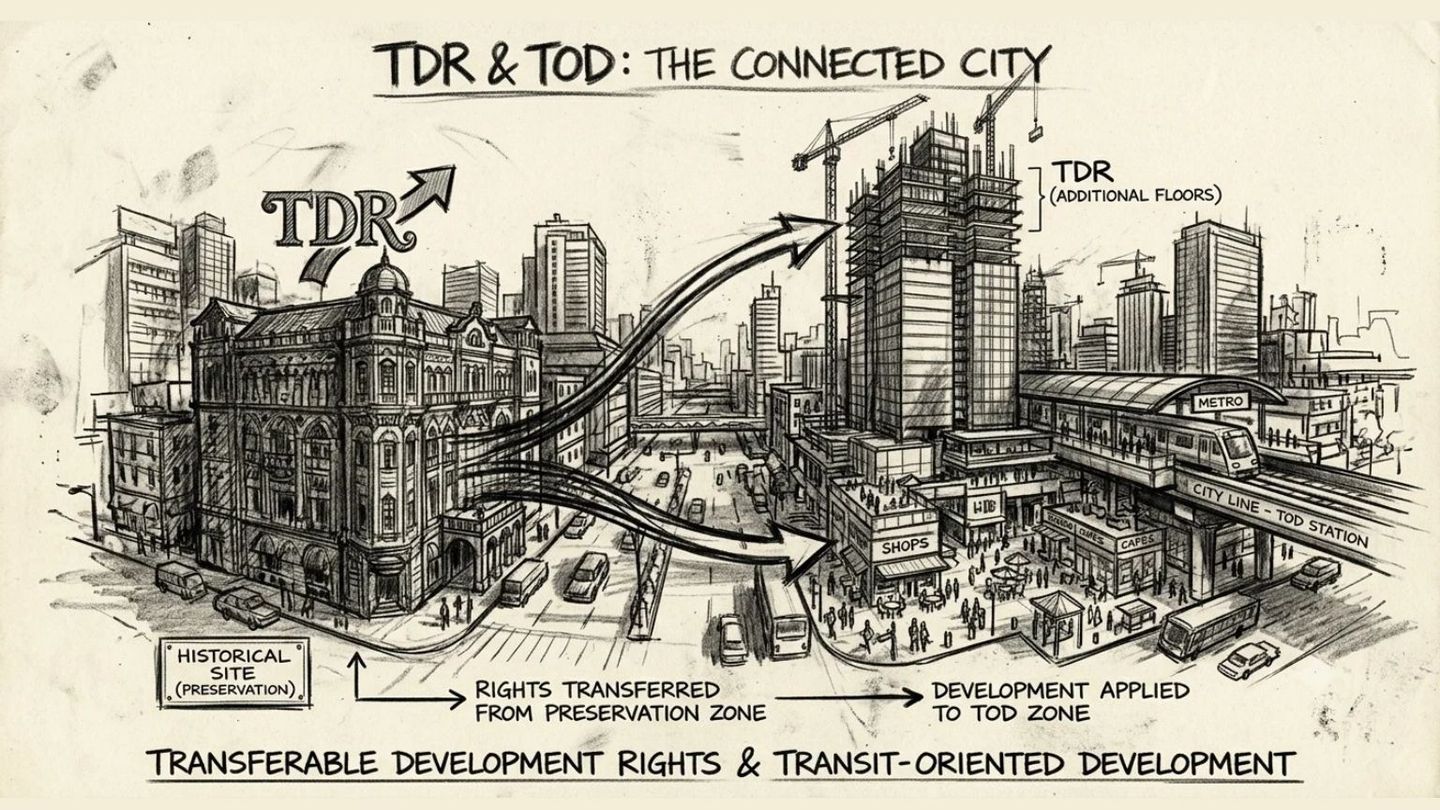
TDR and TOD: The Policy Shifts Redrawing Delhi-Gurgaon’s Real Estate Price Map
Indian real estate is changing, and two key concepts, TDR and TOD are having a big impact on how cities like Delhi and Gurgaon grow and how properties are valued. While many people pay attention to new buildings and construction, the real advantage comes from understanding the rules that decide what can be built and where. This article explains how Transferable Development Rights (TDR) and Transit-Oriented Development (TOD) are affecting property prices and development patterns in the Delhi-Gurgaon area, providing useful insights for investors, developers, and policymakers.
The Policy Shift Hidden in Plain Sight
People often focus on what they can see in real estate like the skyline, cranes, and flashy brochures for new projects. However, rules and regulations decide how much can be built on any piece of land. Zoning laws, density limits, and allowed uses have always set these boundaries. Now, new policies are making these rules more flexible and valuable than before.
You can think of city regulations as the basic system that keeps everything running. Recent changes to TDR and TOD are like an upgrade, adding new options that were not available before. People who understand these changes can do more than just react to the market, they can predict what will happen next.
What Are Transferable Development Rights (TDR)?
TDR is a system that allows landowners to move their unused building rights to a different place. Here is how it works:
- When land is surrendered for public use such as road widening, new parks, or critical infrastructure, the government compensates the landowner not in cash, but with TDR certificates.
- These certificates stand for a certain amount of building potential, such as extra floors or more space, which can be used on another piece of land or sold to a developer.
- Developers, in turn, use these certificates to increase the Floor Area Ratio (FAR) of their projects beyond what the base zoning would normally permit.
This system has become more popular in cities like Gurugram (Gurgaon). For example, in April 2026, the Haryana government raised the allowed Floor Area Ratio (FAR) for retirement housing to 3.0 using TDR. This change made it possible to build larger projects that were not allowed before, creating new opportunities and more available properties.
Structural Benefits and Risks
TDR offers several important benefits:
- Public infrastructure gets funded and built without the government dipping into fiscal reserves.
- Landowners receive fair compensation and new liquidity options.
- Developers gain the flexibility to add density where market demand is strongest.
However, there are also some major risks:
- If the market is flooded with TDR certificates, their value can collapse, undermining the incentive structure.
- Without transparent pricing and trading mechanisms, opacity and manipulation can make it harder for market participants to benchmark fair value.
Gurugram: A TDR-Driven Metamorphosis
Gurugram is a great example of how TDR can change a city. In the last ten years, the city has grown both upward and outward, thanks to the flexible use of TDR. The 2026 increase in FAR for retirement housing is just one case. In many types of real estate, TDR has helped developers build bigger projects and reach new groups of buyers.
For investors, it is important to know which projects have used TDR. These projects often include more built-up space than would have been allowed before. Many are still priced as if these extra benefits do not exist, so there is a chance for investors to find good value.
What Is Transit-Oriented Development (TOD)?
While TDR helps increase building density, TOD focuses on improving connectivity. Transit-Oriented Development means building high-density, mixed-use projects within walking distance, usually 500 to 800 meters of major transit points like metro stations or bus stops.
Why does this matter? Because transit access fundamentally changes the real estate value equation. Historically, every new metro corridor in India has triggered a 10% to 25% rise in property prices in nearby areas within two to three years. The combination of accessibility, shorter commutes, and better amenities creates a powerful upward force on demand and prices.
Delhi-NCR: A Transit-Linked Goldmine
Delhi-NCR is set to see major transit changes. With a growing metro network, new ISBT hubs, and the upcoming Jewar Airport, the area could see 32 million square feet of transit-linked development. In Gurugram, a 188 km metro expansion including the Cyber City loop, Gurugram-Faridabad route, and a Manesar link is expected to start construction soon and finish around 2027.
Properties within 2 km of the new RRTS (Regional Rapid Transit System) stations are already increasing in value faster than the city average. The market is recognizing the benefits of transit access even before the trains start running.
The Price Map: How Proximity to Transit Alters Value
One interesting effect of TOD is that property prices often rise in two stages:
- On Announcement: When a new transit line or station is announced, nearby properties see speculative activity and early investment. Prices begin to climb as expectations are set.
- On Completion: Once the transit infrastructure is operational, the real value is realized. Commute times drop, amenities improve, and demand surges, resulting in a second wave of price appreciation.
For smart investors, the best time to invest is usually after a project is announced but before it is finished. This period lets them benefit from the difference between early speculation and the actual increase in value.
The Policy-Practicality Gap: Bottlenecks and Challenges
Even though TDR and TOD can bring big changes, they also face real challenges:
- Land acquisition can be slow and contentious, delaying project timelines.
- Outdated land-use norms frequently lag behind infrastructure rollouts, limiting the ability to capitalize on new connectivity.
- Financing for large, mixed-use projects remains complex, especially when regulatory clarity is lacking.
- Fragmented governance compounds these issues. In Delhi-NCR, agencies like the DDA, GMDA, Haryana government, and DMRC operate under separate mandates, making coordination difficult. As a result, transit infrastructure often arrives before the density framework is in place, leaving value on the table.
Investor Takeaways: Reading Between the Lines
For investors, the message is clear:
- TDR is a density multiplier. Projects that use TDR deliver built-up area that would not exist under base zoning. These are often undervalued because the market has not fully priced in the new development capacity.
- TOD is an infrastructure multiplier. A metro or major transit node is a powerful anchor. Everything within 500 to 800 meters tends to reprice on announcement and again on completion. Getting in between these two events offers the greatest return potential.
Both TDR and TOD change how land, building density, and value are connected. Understanding how they work matters not just for urban planners, but for anyone who wants to invest wisely for the future.
Actionable Insights: How to Build an Investment Edge
- Monitor policy changes as closely as market activity. The best opportunities arise when regulatory shifts precede market realization.
- Track TDR issuances and certificate trading. Transparency in this market is still developing, but getting in early on new TDR-enabled projects can provide an edge.
- Overlay transit plans with zoning maps to identify underpriced land near future TOD zones.
- Time your entry: The highest returns often accrue to those who invest after a transit project is announced but before it is completed.
- Stay informed about governance and regulatory changes, as these can quickly affect implementation timelines and investment outcomes.
Conclusion
The story of Delhi-Gurgaon’s real estate market is being rewritten not just by cranes and concrete, but by the policy frameworks that determine what and where can be built. Transferable Development Rights (TDR) and Transit-Oriented Development (TOD) are the twin engines driving this change, reshaping the price map in ways the broader market is only beginning to understand.
If you’re willing to dig a little deeper to focus on the rules that shape what’s possible, not just the end results you stand to gain a lot. As policy, density, and connectivity become the real drivers of value, understanding how TDR and TOD work isn’t just for the experts. It’s your secret to making smarter, longer-lasting investments.
FAQ's
What exactly is TDR (Transferable Development Rights)?
TDR allows landowners who surrender land for public use (like road widening or parks) to receive building rights certificates instead of cash, which they can use on another plot or sell to developers to increase construction density.
How does TDR actually increase a project's size?
Developers use TDR certificates to boost the Floor Area Ratio (FAR) of their projects beyond what standard zoning normally allows, enabling larger, denser developments than would otherwise be permitted.
Can you give a real example of TDR in action?
In April 2026, the Haryana government raised the permissible FAR for retirement housing to 3.0 using TDR, enabling significantly larger projects than were previously allowed.
What risks come with the TDR system?
If too many TDR certificates flood the market, their value can collapse. Lack of transparent pricing and trading mechanisms can also make it hard to determine fair value.
What is TOD (Transit-Oriented Development), and how is it different from TDR?
While TDR increases building density, TOD focuses on development near transit hubs, typically within 500-800 meters of metro stations or bus stops, leveraging connectivity to drive property value.
How much have property prices historically risen near new metro corridors?
Properties near new metro corridors in India have typically seen price increases of 10-25% within two to three years of the corridor's introduction.
Does property appreciation near transit happen all at once?
No, it typically happens in two stages: an initial rise on announcement due to speculation, followed by a second, larger appreciation once the transit line actually becomes operational.
When is the best time for investors to buy into a TOD-linked property?
Generally after the transit project is announced but before it's completed, capturing the gap between early speculative pricing and the full value realized once it's operational.
Why don't TDR and TOD benefits always get reflected in property prices right away?
Fragmented governance across agencies, slow land acquisition, and outdated land-use norms often mean transit infrastructure arrives before zoning frameworks catch up, leaving value temporarily unpriced by the market.
How can investors practically use TDR and TOD knowledge to their advantage?
By tracking TDR issuances and transit announcements, overlaying zoning maps with transit plans to spot underpriced land, and timing entry between a transit project's announcement and its completion.