GST on Rental Income: What Every Landlord and Tenant Must Know
In India, while most people know about stamp duty and capital gains tax when dealing with property, one important detail often slips under the radar: GST on rental income. Many investors and tenants think GST is optional or only comes up in rare cases, but the truth is more complicated, and misunderstanding it can be expensive.
This guide covers when GST applies to rental income, the main differences between residential and commercial properties, how the Composition Scheme affects both landlords and tenants, and why it’s important to talk to a GST expert before signing a lease.
Why GST on Rent Is NOT Optional?
GST is not a matter of personal choice for landlords or tenants. Whether GST applies to your rental income depends on:
- Who you are: Are you registered for GST?
- Who your tenant is: Is your tenant registered under GST?
- Purpose of the property: Is the property used for residential or commercial purposes?
These three factors determine whether GST applies and who must collect and pay it.
The Basics: Forward Charge vs. Reverse Charge
- Forward Charge Mechanism: The landlord collects GST from the tenant and pays it to the government.
- Reverse Charge Mechanism: The tenant pays GST directly to the government (applies in certain cases).
GST on Commercial Property Rentals
First, let’s look at commercial properties. The rules are simpler here, but often misunderstood.
If Both Landlord and Tenant Are GST Registered
- GST Rate: 18%
- Mechanism: Forward Charge (Landlord collects GST from tenant)
- Benefit: Tenant can generally claim Input Tax Credit (ITC) on the GST paid.
If Landlord Is NOT GST Registered, but Tenant IS
- GST Rate: 18%
- Mechanism: Reverse Charge (Tenant pays GST directly to the government)
- Effective Date: Applies from October 10, 2024
- Note: The landlord does not collect GST, but the tenant is still responsible for paying it.
If Neither Party Is GST Registered
- GST does not apply.
Key Takeaway:
Many investors overlook GST registration status. If either party is unregistered, the rules shift, and noncompliance can result in penalties.
GST on Residential Property Rentals
This is where things get confusing. The rules depend on how the property is used and whether the landlord and tenant are registered for GST.
Residential Property Rented for Personal Use
- GST Status: Fully exempt from GST.
- Who Benefits: Both landlord and tenant, regardless of GST registration.
Example: If you rent an apartment to a family for personal use, no GST is payable, whether the landlord or tenant is GST registered.
Residential Property Rented for Commercial Use
In this case, the rules are very different.
- If the landlord is GST Registered:
- GST Rate: 18%
- Mechanism: Forward Charge
- If Landlord is NOT GST Registered, but Tenant IS:
- GST Rate: 18%
- Mechanism: Reverse Charge (tenant pays directly)
- Effective Date: From July 2022
- If Neither Party is GST Registered:
- No GST applies.
Example: If a company rents a flat for use as an office, and the landlord is GST registered, GST applies. If the landlord is not registered but the tenant is, the tenant must pay GST under Reverse Charge.
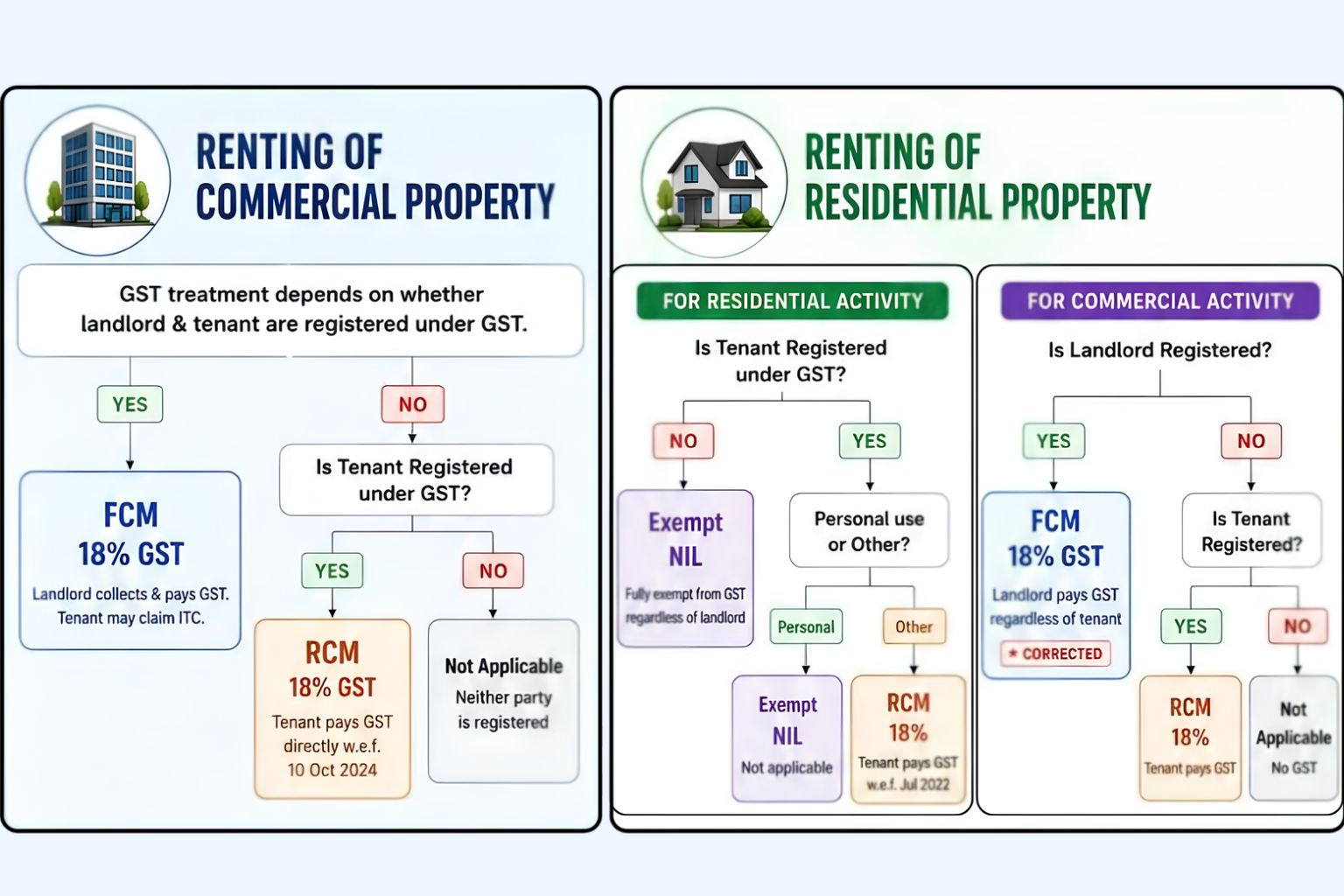
Comparison on GST on Commercial Rental Property & Residential Rental Property
Find the comparison below on both types of properties:
The Composition Scheme Trap
This part of GST on rentals is often missed and can lead to unexpected problems for both landlords and tenants.
What is the Composition Scheme?
It’s a simplified GST payment scheme for small taxpayers, generally restricting them from charging GST on most goods and services.
Impact on Landlords:
- Rental Income = Service: Under Section 10(1) of the CGST Act, renting property is considered a service.
- Outside Composition Scheme: Landlords cannot use the Composition Scheme for rental income. If they want to rent out property and collect GST, they must register under the normal GST regime for that income.
- Action Required: May need to opt out of the Composition Scheme or register separately for rental services.
Impact on Tenants:
- Composition Dealer as Tenant: If a tenant under the Composition Scheme rents from an unregistered landlord and Reverse Charge applies, the tenant loses eligibility to remain under the Composition Scheme (per Section 10(2)(d) of the CGST Act).
As a result, both landlords and tenants could lose the benefits of the Composition Scheme and might break GST rules without realizing it.
How to Avoid GST Pitfalls as a Landlord or Tenant?
Use this practical checklist to help you avoid mistakes:
- Determine GST registration status for both landlord and tenant.
- Clarify the intended use of the property: residential or commercial.
- Understand the rental supply type: Is it a service under GST?
- Check for Reverse Charge applicability, especially if one party is unregistered.
- Check your Composition Scheme status to ensure you don’t lose eligibility because of rental transactions.
- Consult a GST professional before signing any lease or rental agreement.
Typical Misconceptions That Lead to Costly Mistakes
- “Residential rentals are always exempt.” Not true if the property is used for commercial purposes.
- “Only landlords need to worry about GST.” Tenants, especially registered ones, can be liable under Reverse Charge.
- “I’m on the Composition Scheme, so I’m safe.” Renting property can force you out of the scheme.
Conclusion
The main point about GST on rentals is simple but often missed. How the tax applies depends on the GST registration status of both parties and how the property will be used. If you get these details wrong, you could face unexpected taxes, penalties, or lose your tax scheme eligibility.
Before entering any rental or lease arrangement, always:
- Map the GST status of both parties,
- Identify the use of the property,
- Understand the transaction structure.
Don’t assume that 'residential' always means 'exempt' or that 'commercial' is always simple. The rules are specific, and not knowing them is not an excuse under tax law.
Consult a GST professional to ensure your transaction is compliant and optimized before you sign the dotted line.
FAQ's
Is residential property rental always exempt from GST?
No. This is a common misconception. Residential property rented for personal use is fully exempt, but if it's rented for commercial use (like a company using it as an office), GST at 18% can apply depending on the parties' registration status.
Who actually pays GST when renting out commercial property?
If both landlord and tenant are GST registered, the landlord collects GST from the tenant under Forward Charge. If only the tenant is registered, the tenant pays GST directly to the government under Reverse Charge.
What happens if neither the landlord nor tenant is GST registered?
GST doesn't apply at all, whether the property is residential or commercial, as long as neither party is registered.
If my landlord isn't GST registered, am I as the tenant off the hook for GST?
Not necessarily. If you, as the tenant, are GST registered and the landlord isn't, you may still be liable to pay GST directly to the government under the Reverse Charge Mechanism.
Can a landlord under the Composition Scheme still rent out property?
Rental income is treated as a service, which falls outside the Composition Scheme. Landlords earning rental income generally need to register under the normal GST regime for that income.
Can renting property affect a tenant's Composition Scheme eligibility?
Yes. If a tenant under the Composition Scheme rents from an unregistered landlord and Reverse Charge applies, they can lose their Composition Scheme eligibility altogether.
Does GST on residential-for-commercial-use rentals apply from a specific date?
Yes. The Reverse Charge Mechanism for residential property rented for commercial use by an unregistered landlord to a registered tenant has applied since July 2022.
What should tenants and landlords do before signing a lease to avoid GST issues?
Confirm both parties' GST registration status, clarify whether the property will be used residentially or commercially, check if Reverse Charge applies, and consult a GST professional beforehand.